White paper

White paper
Missy Speyrer··17 min read

“We knew the moment we stepped on campus that this was the school for us.”
It’s a phrase admissions teams hear often and for good reason. Personal, on-campus experiences are often the tipping point in school decisions. The catch? Earning those on-campus moments.
Families are researching ahead of time and making decisions before stepping foot onto campus. What if families are ruling out your school before scheduling a tour and a shadow day for their child[ren]?
Strategic school marketing that tells a compelling, authentic story will position schools for the moments that win families over.
TL;DR — What You Need to Know
Admissions and marketing teams must work in lockstep to craft a compelling message to earn the right for families to step onto campus. Your website, ads, and outreach need to tell a consistent story that draws families in, making them want to go deeper. And once they do, it’s the human interactions, student shadow days, warm welcomes, and personal conversations that leave the lasting impression.
This whitepaper distills insights from 132 newly enrolled private school families across the United States.
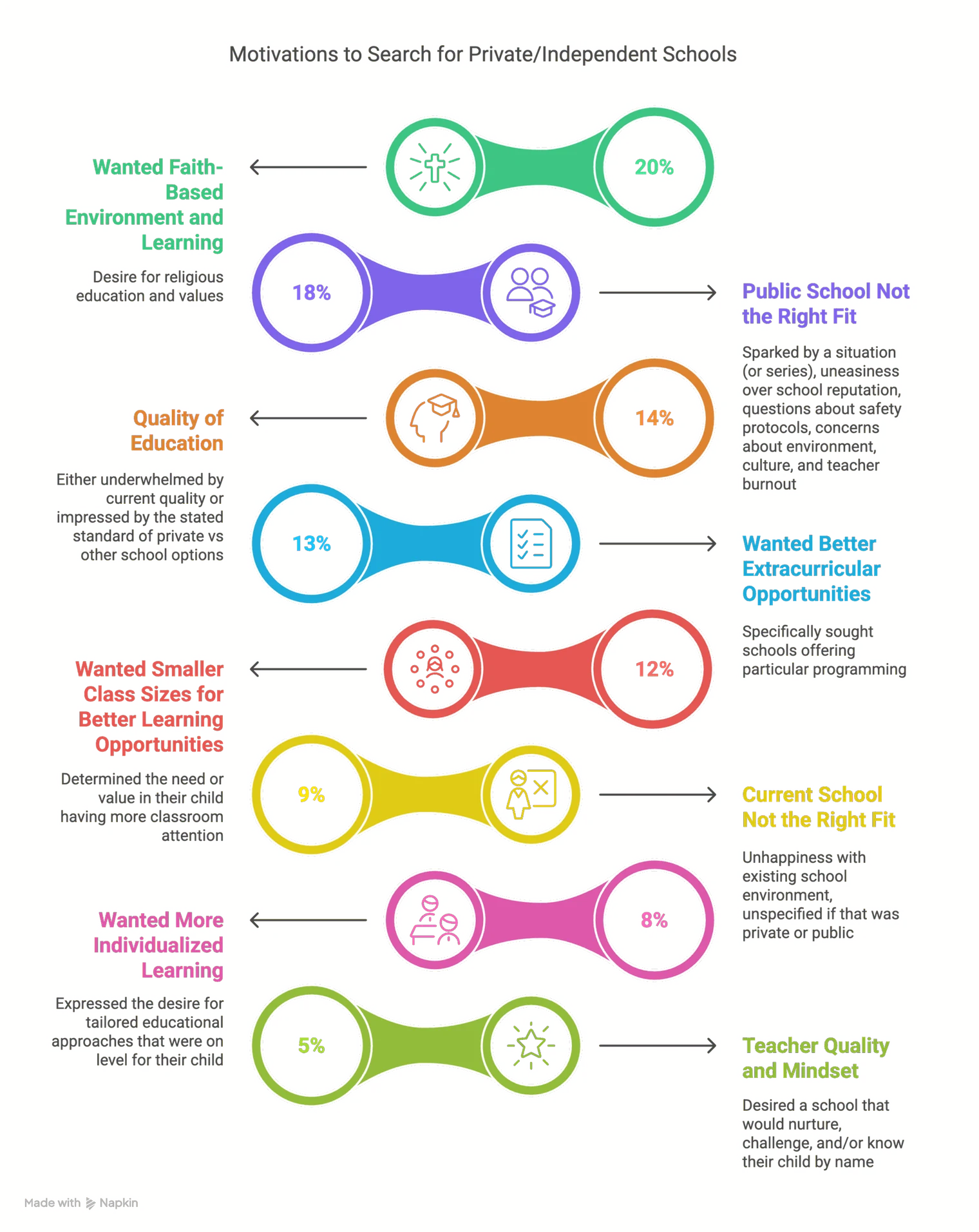
Q: What motivated you to search for a private school?
We began by wanting to know the motivations behind starting the search in the first place. While some tours might turn into bashing sessions over a particular school or situation, some prospective families hold things a bit closer to the cuff. The top 8 themes identified throughout the responses fall into the overarching perspective that parents want their child[ren] to be in a safe, nurturing, challenging environment. While none of these stand as a surprising notion, the initial reasoning for researching school options didn’t always align with the responder’s “most important quality” once deeper evaluations were underway.
Note: Within the 132 open-ended responses to this initial question, many themes were identified. Those that came in below 5% ranged from relocating or a child requesting the switch to a mention from a colleague or extended family member about the need for a new school environment.
There was an outlier within the responses that 20% of families desired a faith-based education.
💡 What Families Say → What Schools Should Do
Prospective families…
School marketing & admissions teams should…
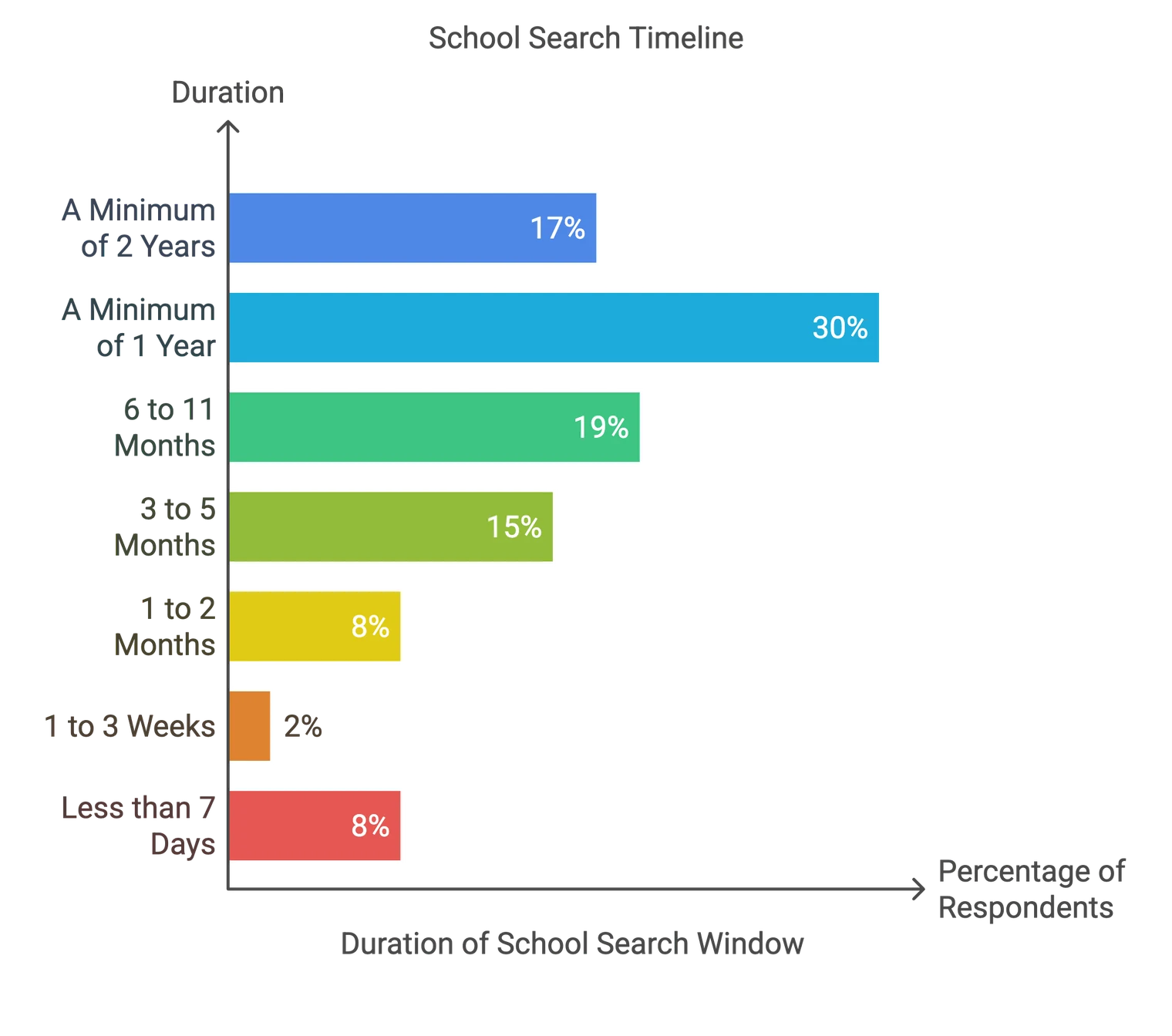
Q: How many days, weeks, months, or years prior to enrolling did you start searching?
As more and more information is readily available and accessible online, the research window has grown far beyond enrolling at the nearest or rumored ‘best’ school. Prospective families are embarking on an investment, financially, emotionally, and futuristically. Regardless of the initial reason to begin exploring school options, the responses portray the due diligence taken by 47% who spent a minimum of 12 months researching and evaluating their options.
The 10% that made their decision in less than a month were legacies enrolling their children where at least one parent attended or families who felt the chosen school sat echelons above other options in the area. Case in point: “this was the only school we pursued”.
Tip! With more and more families doing thorough–and lengthy!–research, outfit your touchpoints with that in mind. Construct an email drip that keeps you relevant with families who engage well before their child is age-appropriate for your school. Furthermore, utilize conversion tracking that tells the full story. Knowing a newly enrolled family signed up for your newsletter or downloaded an e-book five years ago is a defining approach. Is the e-book still available to prospective parents? Does it need updating? Is the newsletter routinely updated with current information? Which parts of the newsletter garnered that family’s attention?
💡 What Families Say → What Schools Should Do
Prospective families…
School marketing & admissions teams should…
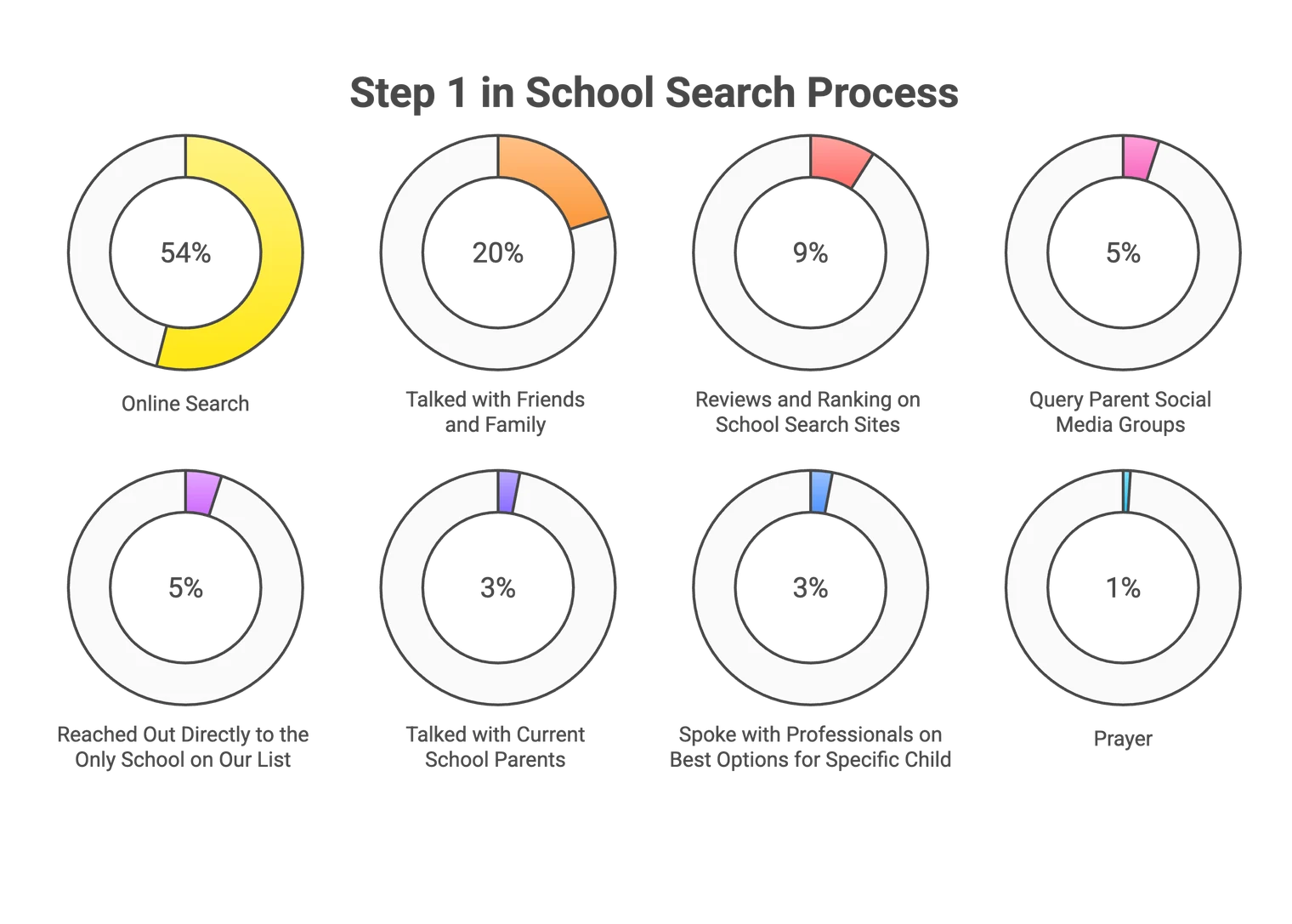
Q: What was the first step in your search process?
When drilling down into each responder’s first step after deciding to look into private school options, the leading methods were, unsurprisingly, online and word-of-mouth.
To meet the 54% that began with an online search, schools must outfit their digital footprint with consistent messaging across multiple touchpoints that align with their intended audience. Not every platform nor every audience segment is built the same, so maintain aligned messaging while adjusting the content to the platform. What prospective parents and students find on a school’s website, social channels, and Private School Review profile will certainly feel different from one another, but each should be telling the same story.
💡 What Families Say → What Schools Should Do
Prospective families…
School marketing & admissions teams should…
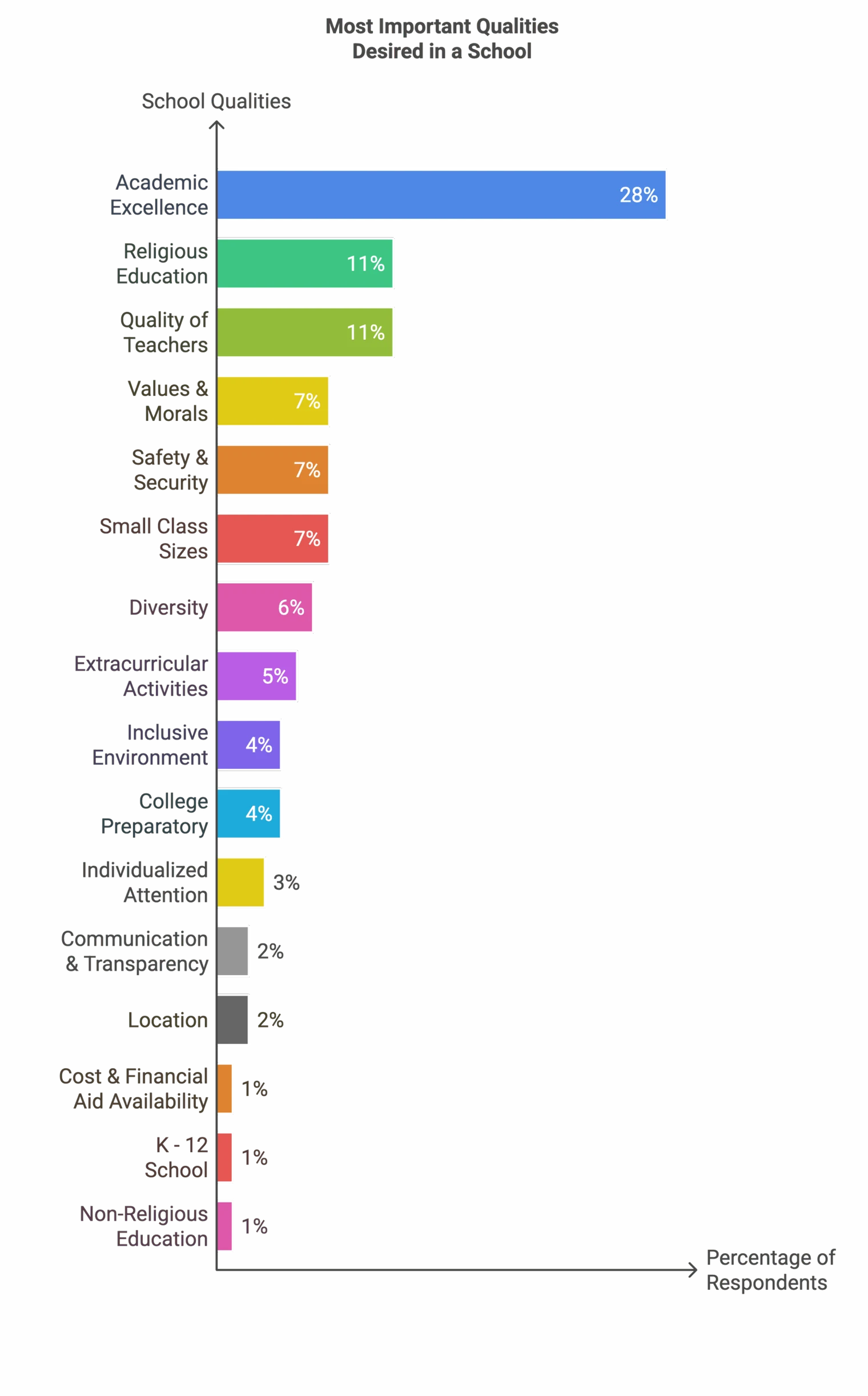
Q: What was the most important quality you were looking for in a school?
This question was meant to know a prospective family’s ‘true north’ throughout their search. What were they looking for most? What were their main decision determinants?
The top 3 responses were reminiscent of ‘initial motivators’ touched on a few sections before this one.
It’s possible that families seeking a religious education only had faith-based schools on their list by this point, so the focus then shifted to academics or safety. There is also a correlation between seeking high-quality teachers and academic rigor. The two do not always go hand-in-hand, but the case can be made that one must have top faculty to have academic excellence. In the same breath, the case can be made that ‘high-quality teacher’ could refer to the demeanor and classroom style of the teacher versus having a Phd and being the brightest educator this side of the equator.
The bottom line here is that the majority of parents searching identified academics as the main focus.
💡 What Families Say → What Schools Should Do
Prospective families…
School marketing & admissions teams should…
*For strong GSO (Generative Search Optimization), schools still need detailed curriculum and pedagogy content, but it doesn’t have to be on the homepage.
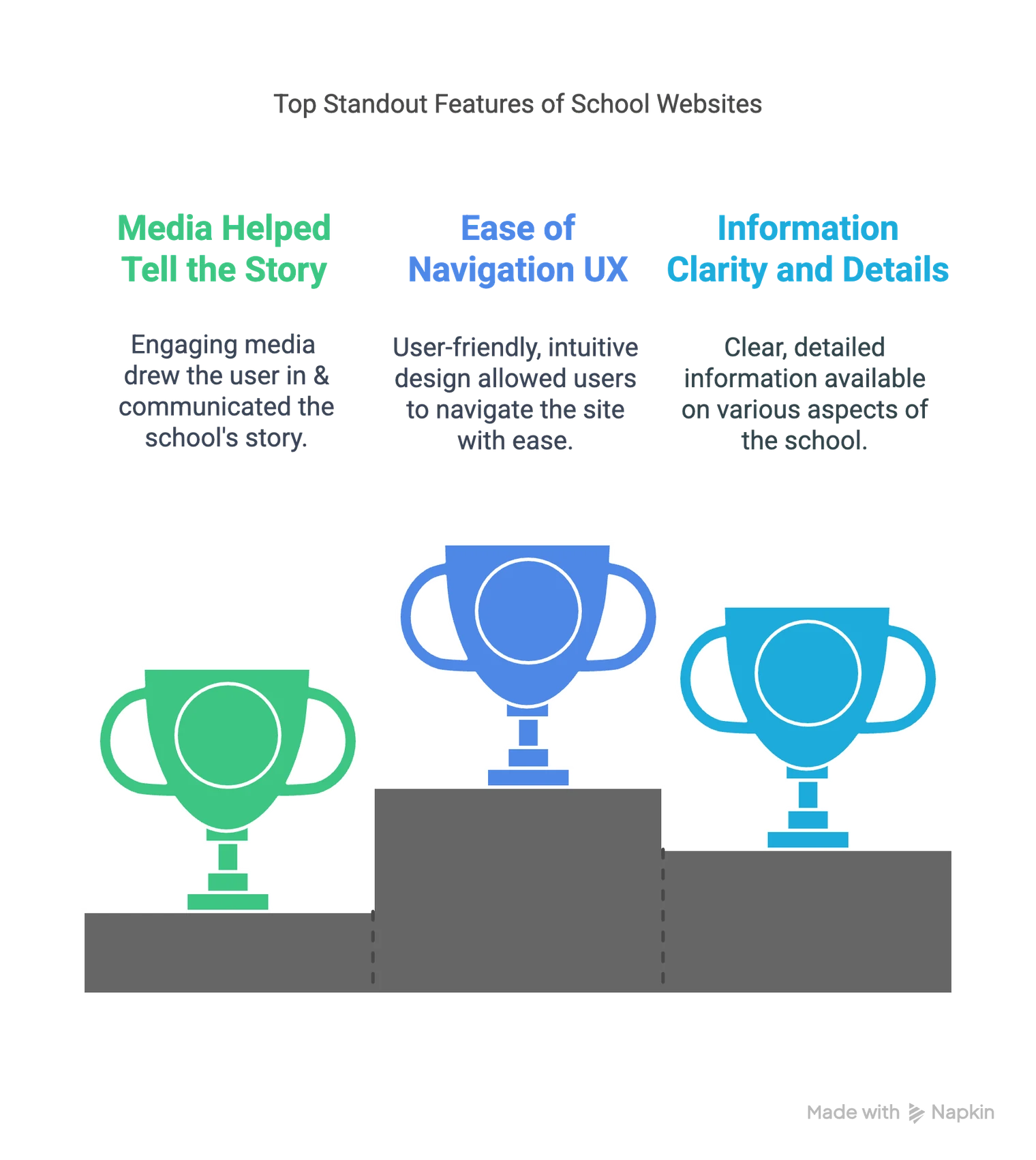
Q: What did you like most about the schools’ websites you visited?
Websites have to strike a balance in so many ways. Not only do schools need to tell their story with high-quality images so that parents and guardians get a feel for who they are as a school, but the inner workings of the site have to play by certain rules, too. While “inner workings” can truly mean content behind-the-scenes like Alt Tags, Meta Tags, and image dimensions and size, it can also mean proper use of on-page keywords and regularly updated content for domain authority.
A school’s website will likely be a prospective family’s first impression. As mentioned earlier, 54% of respondents began their search online, so schools need to continually audit and update their websites. These are the top 3 website elements that stood out to searching families, but we have an expanded breakdown below.
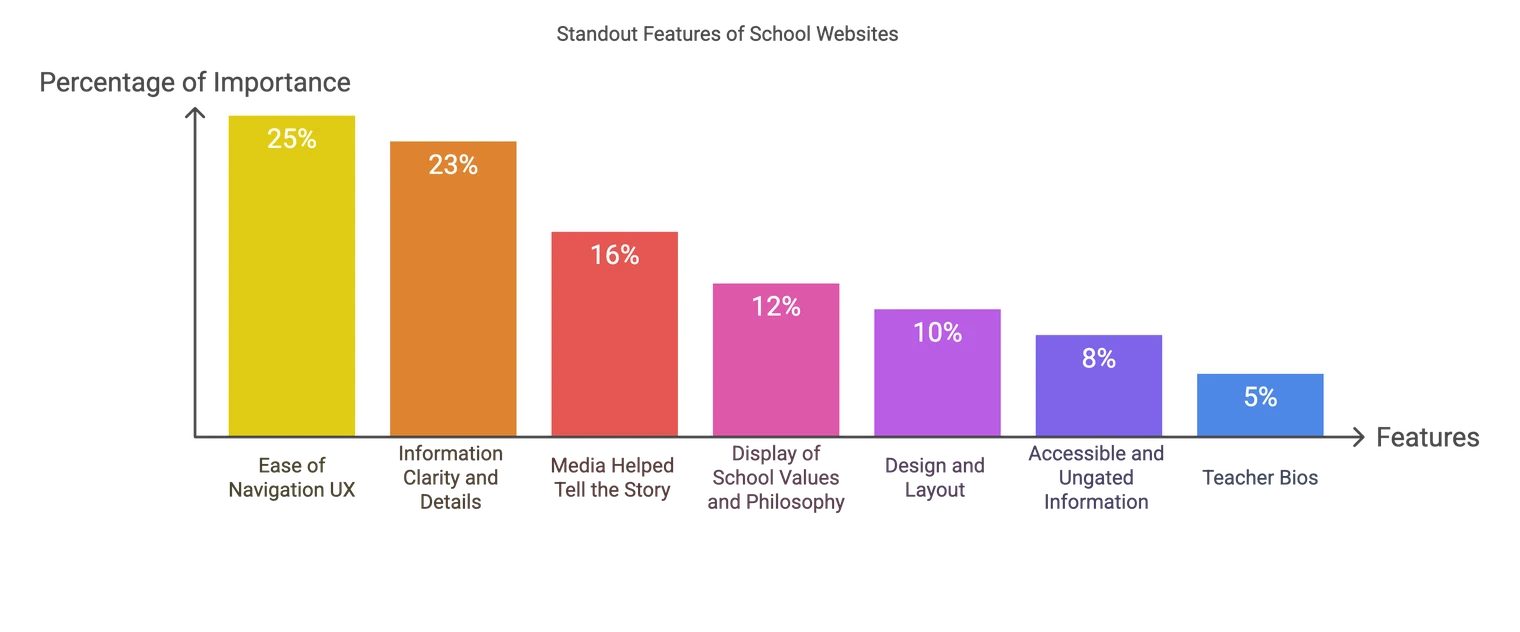
💡 What Families Say → What Schools Should Do
Prospective families…
School marketing & admissions teams should…
Q: What did you like least about the schools’ websites you visited?
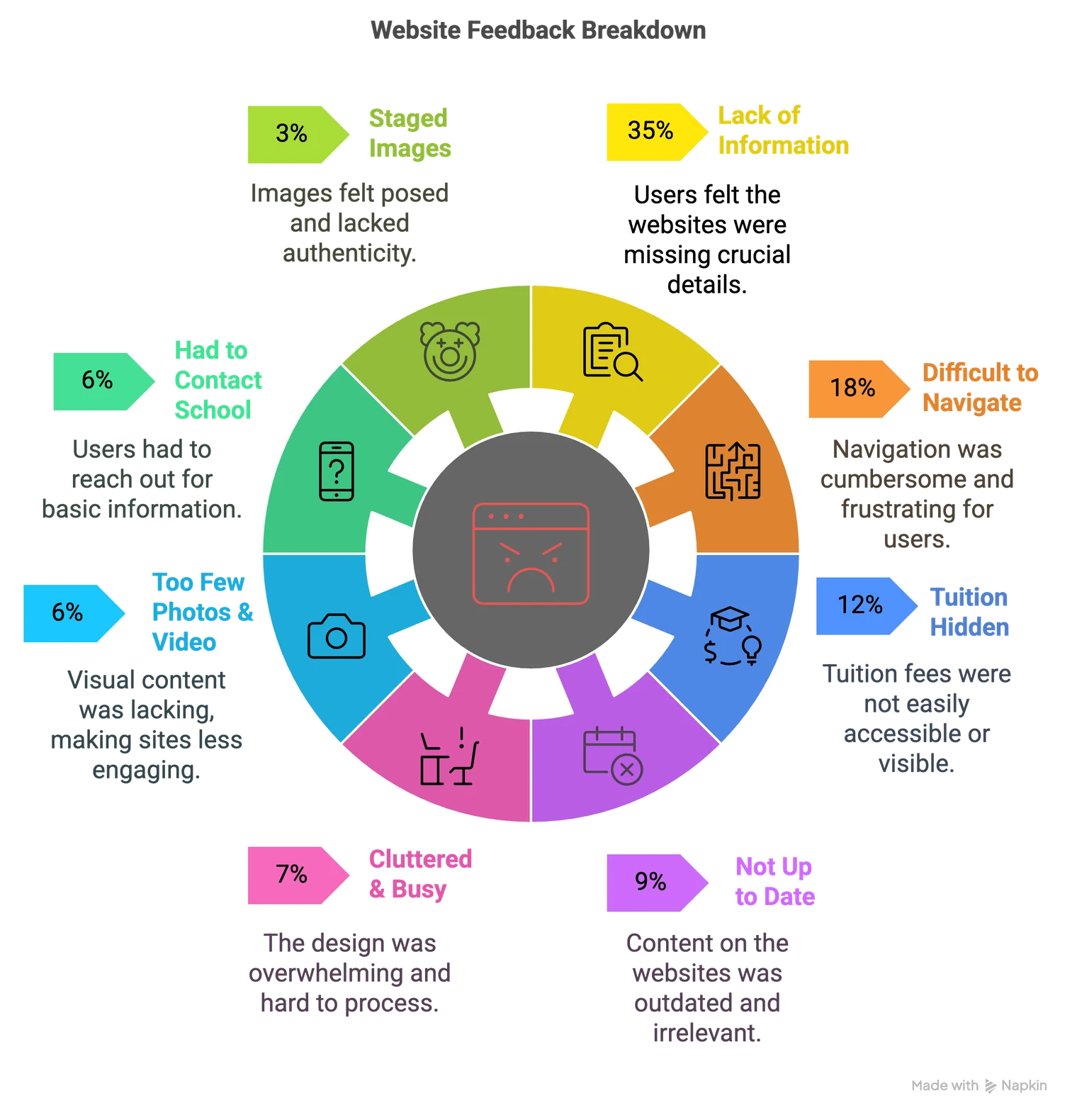
The main complaints regarding school websites were the navigation, sparse information, and gated tuition rates. With the rise in online research and instant information, the last thing a parent wants to do is fill out a form or type an email requesting tuition rates. For the schools that frame their tuition page in this way, it would be an interesting A/B test of that version vs strategic storytelling that portrays the value attached to the investment.
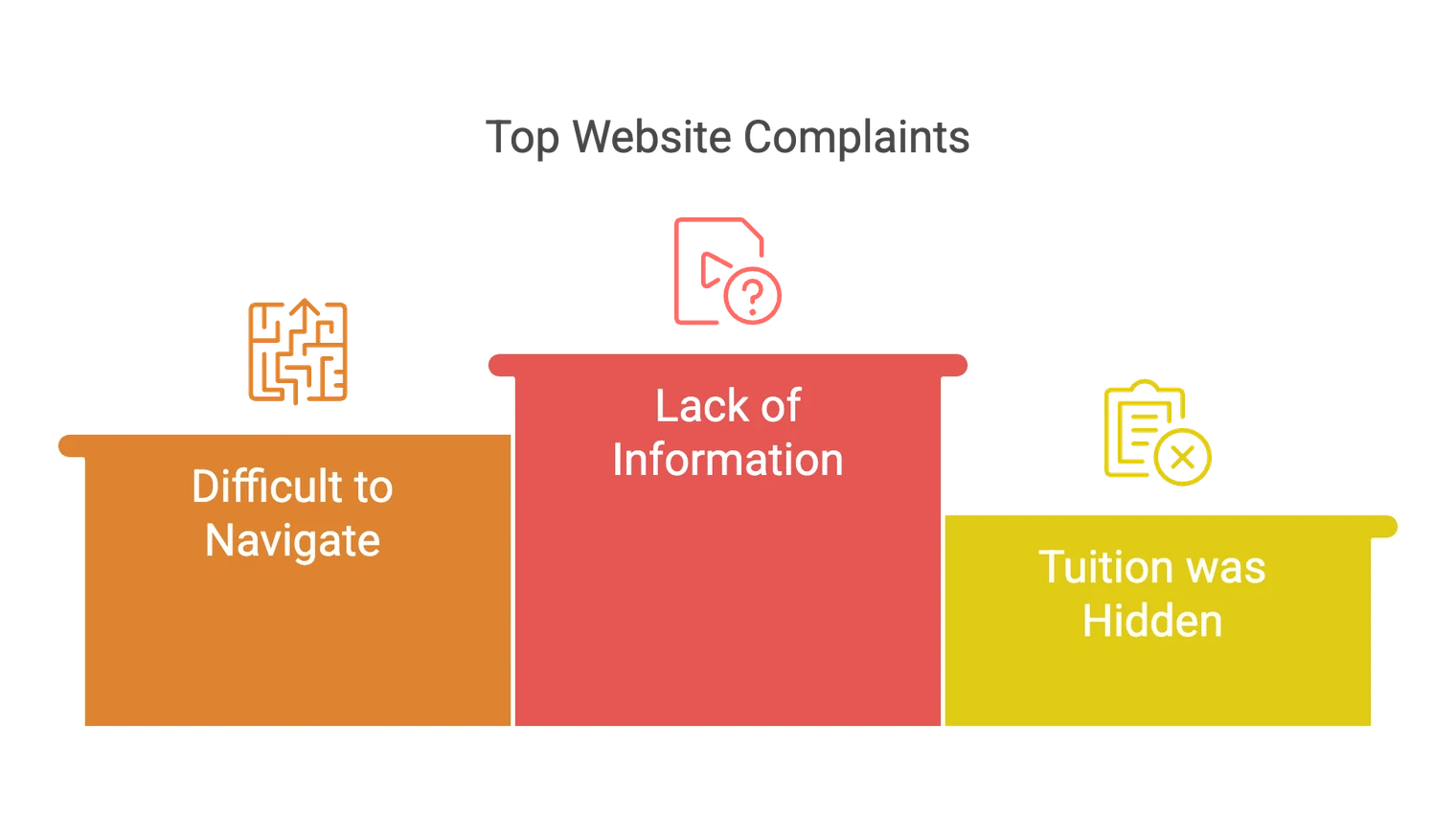
Beyond the top three complaints, parents and guardians were unimpressed with outdated, staged, and overly busy sites. These likely conveyed a lack of attention and authenticity, even though the root cause is more likely attributed to a small team handling too much with a low budget that doesn’t leave room for professional, high-quality images and video.
💡 What Families Say → What Schools Should Do
Prospective families…
School marketing & admissions teams should…
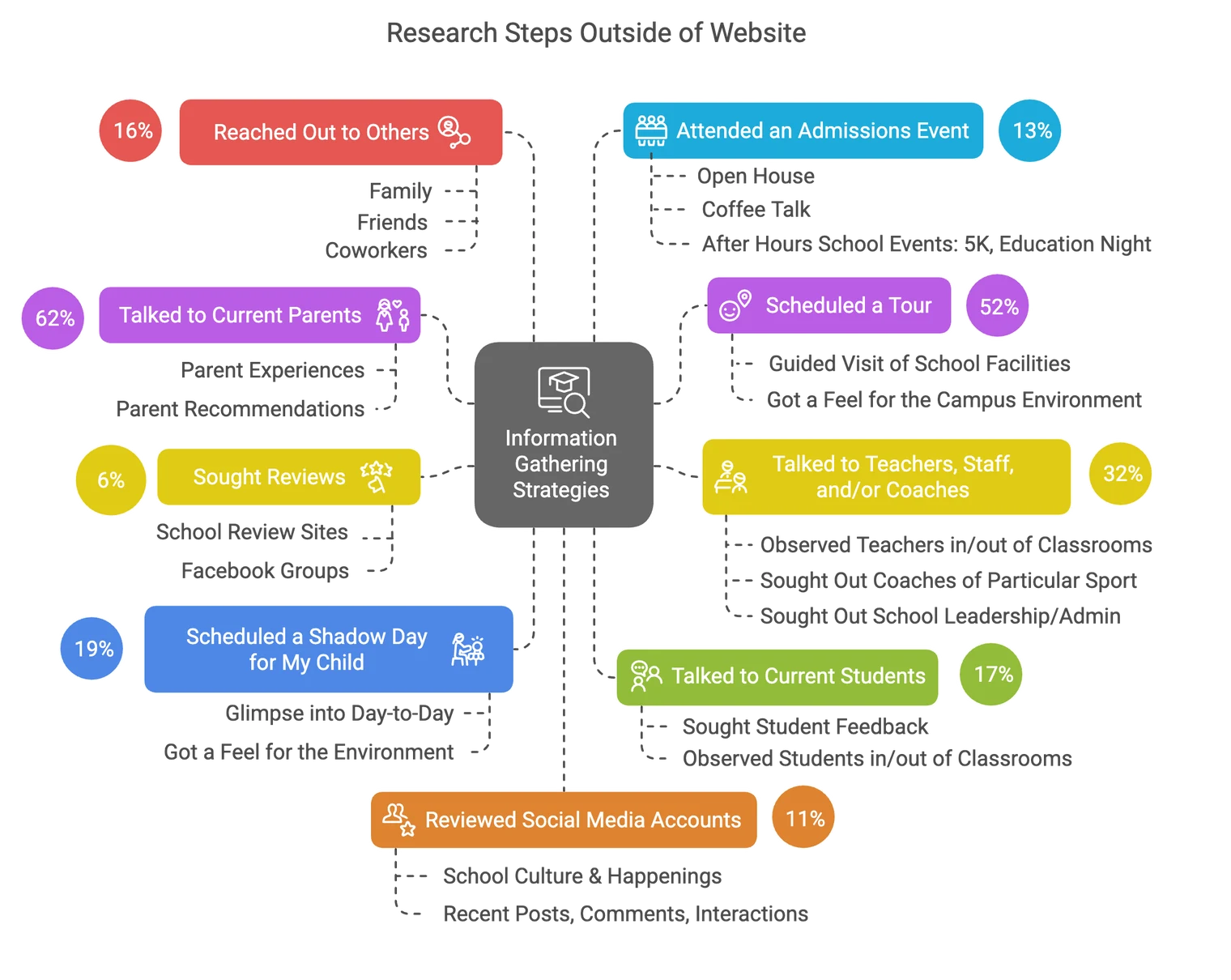
Q: What are 3-5 things you did to learn more about your current school beyond visiting their website?
We asked respondents to share the steps they took beyond exploring the school website. The top three responses stressed parents’ desire to be on campus, interact with staff and teachers, and garner feedback from enrolled families. Most parents scheduled tours to get a better feel for the school, while a smaller number scheduled student shadow days.
Schools often say, “We know we can win them over if we get them on campus”, and yet, so few require tours and shadow days. Seven Hills School is a boys-only middle school in Richmond, Virginia, that requires shadow days for all applicants.
“Because we know that more than 50% of our incoming students (5th and 6th graders) have substantial or total influence in where they enroll, the shadow day is a great way for the our applicants to get a better feel of our school by being an active participant; not just walking around on a tour, seeing buildings, and being told what the school is all about, but experiencing the classes, breaks, and talking and interacting with current students. The prospective student always has a “shadow buddy” (current student) who is his shepherd through the day. The shadow day is also a chance for us to get to know the applicant better beyond what he looks like on paper.”
Drew Lineberger
Assistant Head of School for Advancement, Seven Hills School
A tour can make or break a family’s experience with your school. This is where parents get to see the who, what, when, and where to back up everything they’ve read and seen online or heard from their circle. And a shadow day or student visit is where students get to experience the school in action.
We’ll dive into this a bit more later, but the following elements of a good campus tour can greatly impact a family’s decision to take the next step with your school:
Aside from stepping onto campus for a tour, shadow day, or event, 62% of responses noted conversations with current families as a determining factor. Whether through a website plugin or posting in Facebook groups to garner feedback, parents want to hear about experiences from other parents.
“Knowing how critical a conversation with a current parent can be for prospective families deciding on a school, we created a way for prospects to request a conversation with one of six parent ambassadors who volunteered to connect with parents in this way.”
Heather Burchfield
Current Director of Partner Success, Truth Tree | Former Director of Marketing & Communications, The Peck School
💡 What Families Say → What Schools Should Do
Prospective families…
School marketing & admissions teams should…
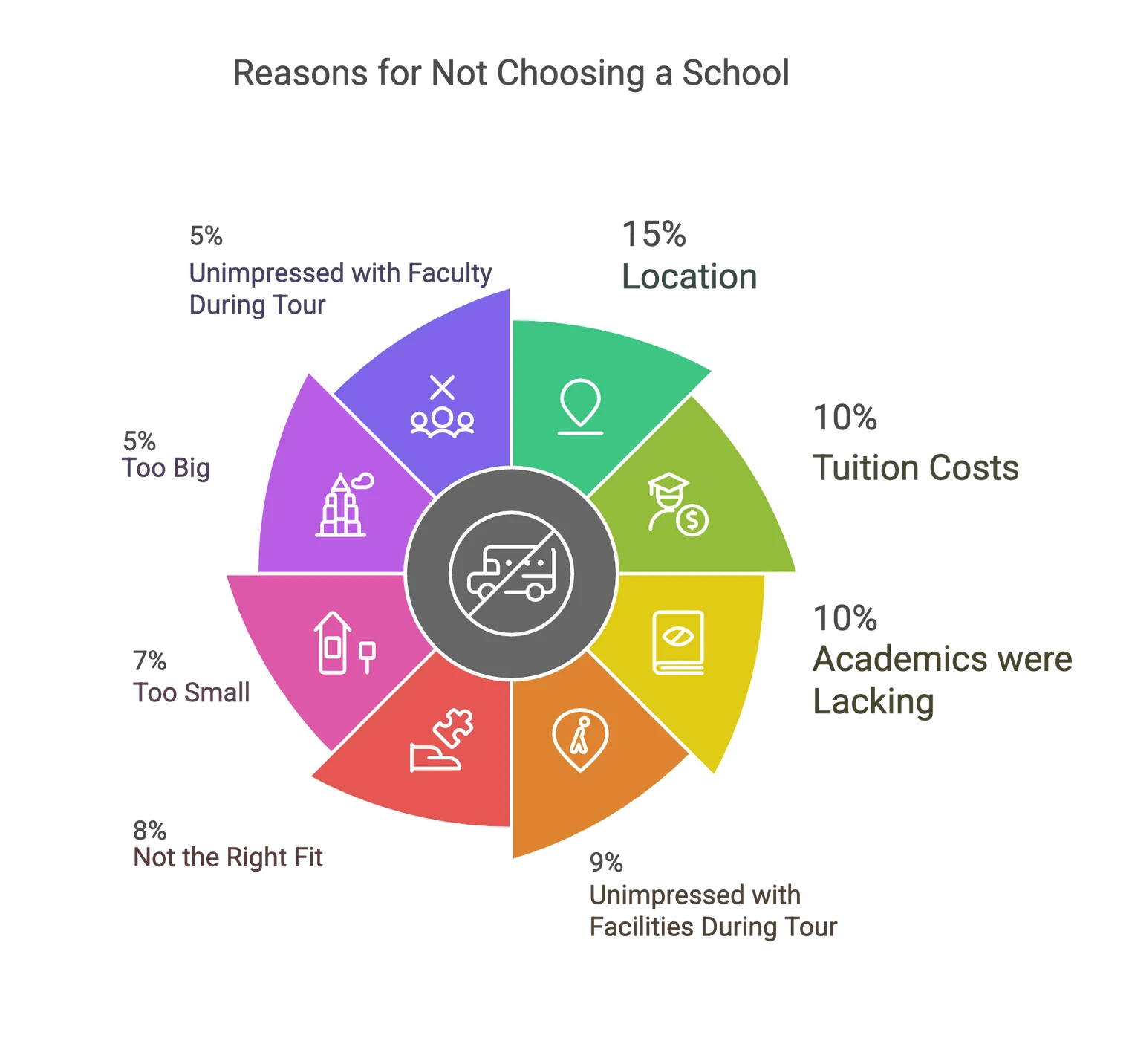
Q: For schools you didn’t pursue further, what was the primary reason?
For the families that researched, toured, and vetted more than one school option, we asked for their top discrepancies during their search. What made them cross a school off of their list? Within the responses, there were 16 themes identified; here are the top 8 reasons families crossed a school off of their list.
While a handful of these points are intrinsic to each individual school, it’s worth noting that not every family is a right fit for your school and vice versa. And still, there are certain themes to avoid. As mentioned above, what families experience during on-campus visits will weigh heavily into their decision.
Does this mean schools need to put on a performance for each and every tour? While this might seem like a great idea on the surface to get more students enrolled, if it’s not authentic, the families will see through the veil a few weeks into the school year.
Consider inviting teachers and students to help with admissions:
💡 What Families Say → What Schools Should Do
Prospective families…
School marketing & admissions teams should…
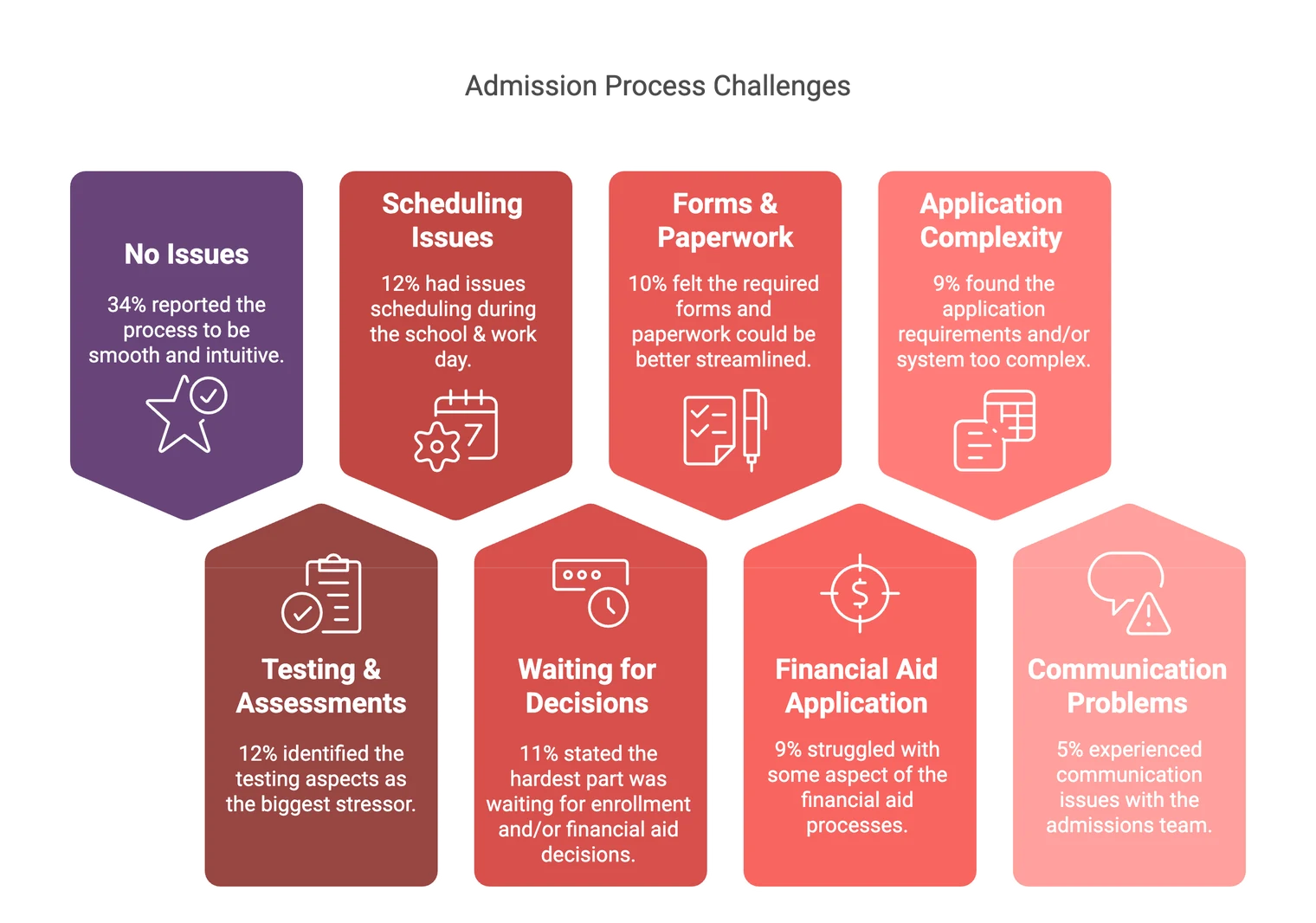
Q: What part of the admission process was the most difficult?
From areas with a universal application to schools with applications that rival Google search results in length, 34% of respondents had no issues. They found the application to be self-explanatory or were guided efficiently by the admissions team.
For the remaining trends, many respondents identified pain points from their school admissions experience, but they also conveyed understanding of the need. For instance, parents noted difficulties in scheduling tours, shadow days, assessments, and testing during work and school hours. While it’s inconvenient and somewhat tricky, parents admitted there’s likely not a ‘perfect way’ for everyone.
The good news is that at this point, you’ve already won them over enough to apply, but it’s still wise to remove as much friction as possible for a new family to start with your school. This could be as simple as adding testing and assessment days on one Saturday per semester, utilizing online calendar scheduling, or reviewing your Financial Aid process each year to identify ways to lessen the burden on families.
💡 What Families Say → What Schools Should Do
Prospective families…
School marketing & admissions teams should…
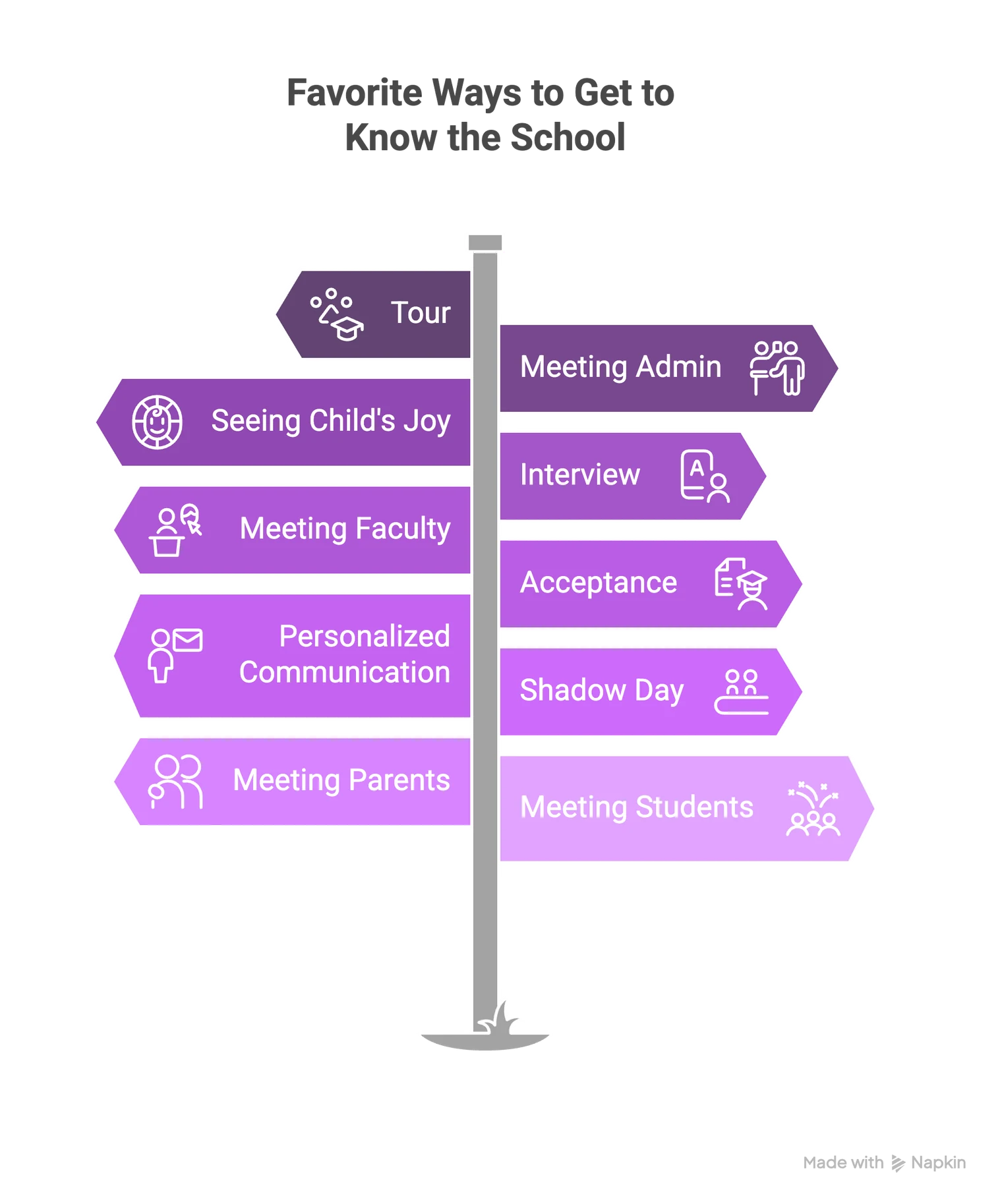
Q: What was the most memorable part of the admissions process?
When asked which part of the admissions process stood out, newly enrolled families noted the personal, relationship-driven moments. The most common responses centered on experiences that helped them connect with the people and culture of the school, whether through a tour, a shadow day, personalized communication, or seeing their child’s excitement during a visit.
The data shows that what stands out most isn’t a polished presentation, but the chance to interact with those who shape the daily life of the school: faculty, students, parents, and administrators. Families remembered conversations, feelings of welcome, and moments that helped them picture their child thriving there.
💡 What Families Say → What Schools Should Do
Prospective families…
School marketing & admissions teams should…
Q: If you could quantify it, what percent of the final decision did your child have?
So when it all comes down to it, how much influence did students have over the matter?
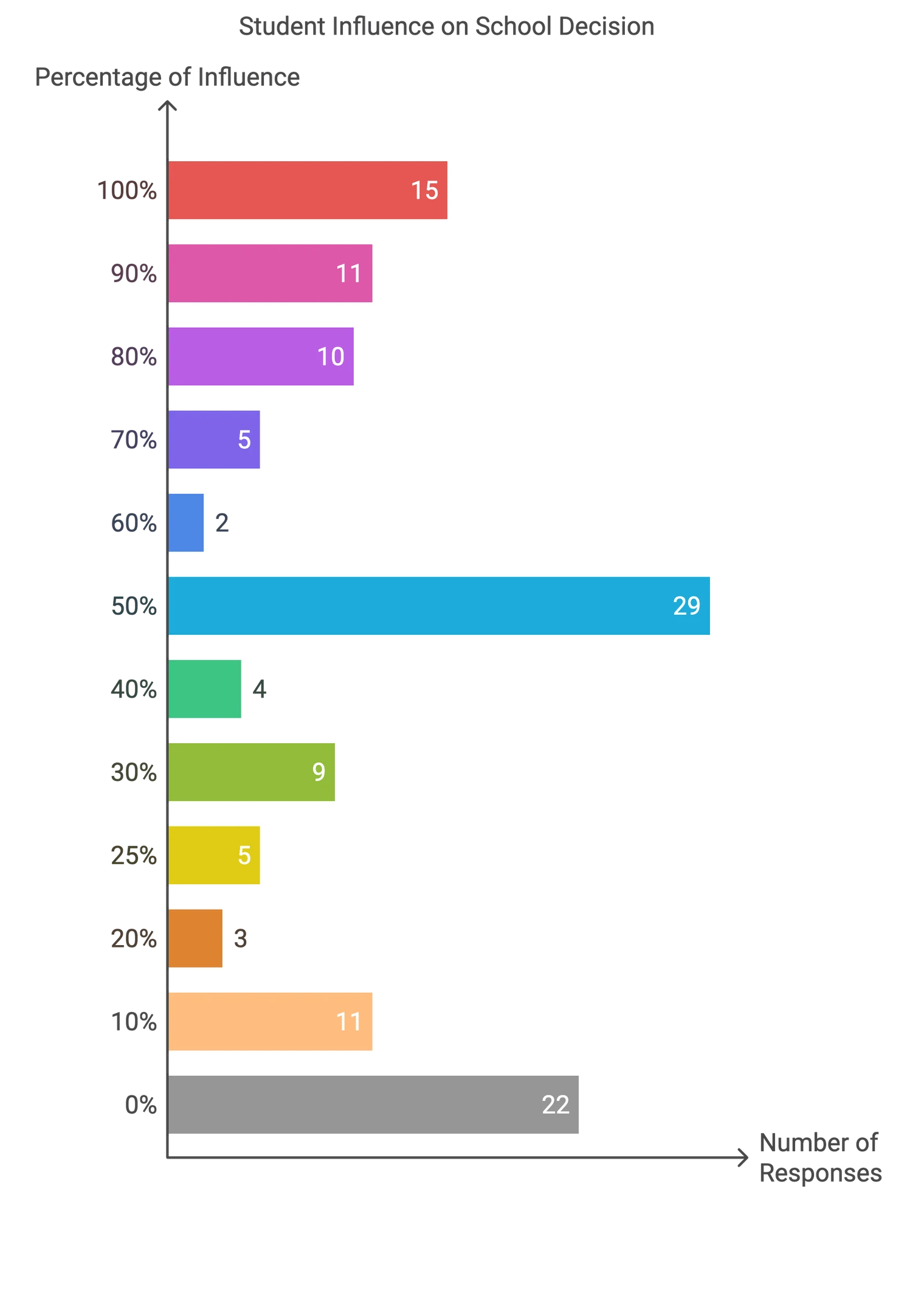
When assessing the responses, 63% reported that their child had 50%+ influence on the decision of where to enroll with 12% having 100% say.
Interestingly enough, 8 of the 25 preschool-aged children had 50%+ sway in the decision with 3 students accounting for 100% on the final decision.
At the elementary level, 18 of the 50 prospective students had 50%+ decision-making power while 20 of the 27 middle schoolers had that same influence on the final decision. Only 2 elementary students and 1 middle school student held 100% influence on where to enroll.
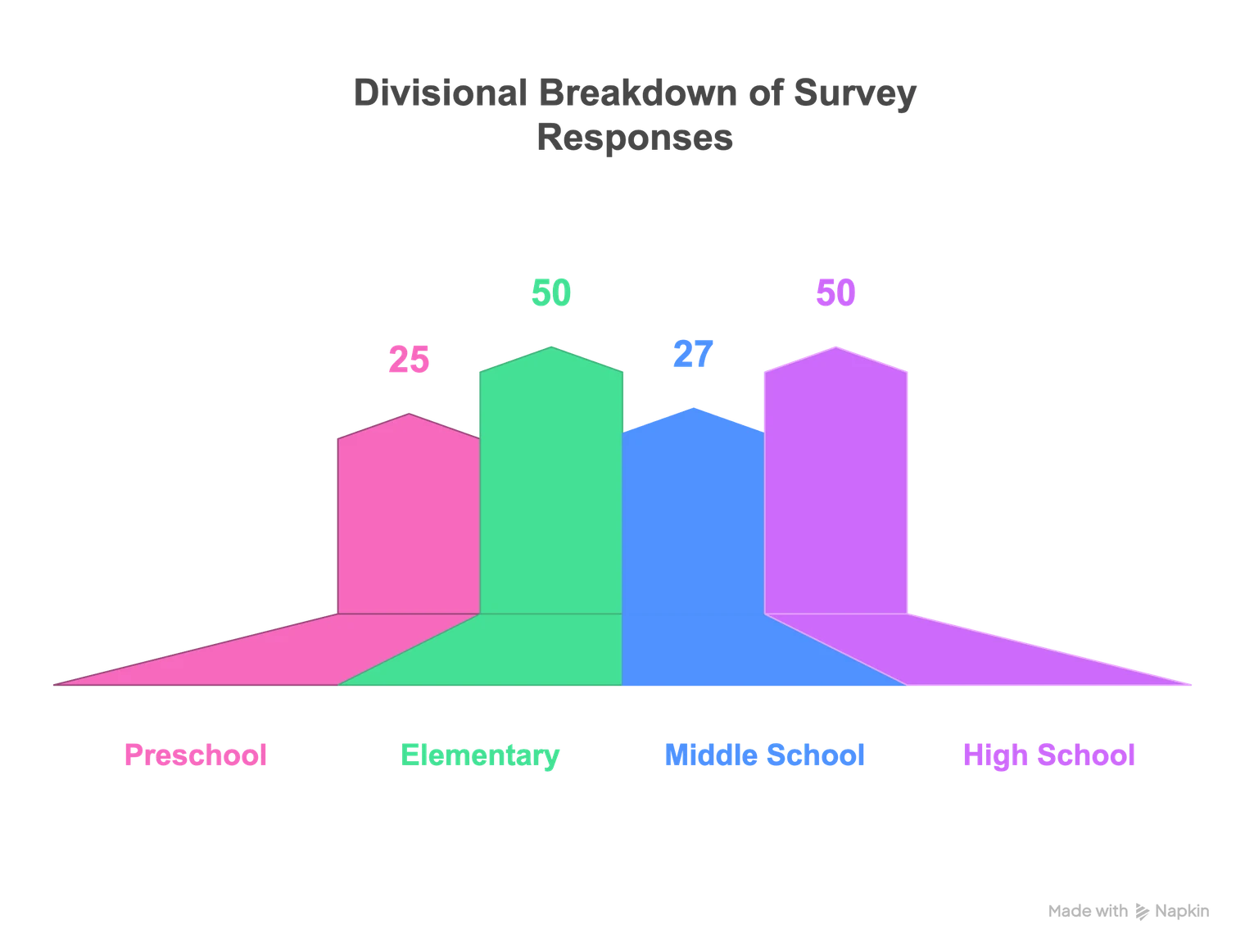
The oldest division represented in our survey, high school, accounted for 50 respondents. Out of those 50, 36 families reported that their child had 50%+ influence on the final decision. When we zoom in on the 50 high school responses, 72% held 50%+ sway with 18% having 100% influence.
Of the students holding 0% decision-making power, only two of those students were at the high school level.
Schools need to devote a layer of their marketing efforts to prospective students. What are the ways a school can build rapport with a student before the tour or shadow day comes into play? Are there ways to invite current students to guide content and/or even develop pieces?
Creative ways to include student-generated content that builds connection:
💡 What Families Say → What Schools Should Do
Prospective families…
School marketing & admissions teams should…
The fine print:
To gain deeper insight into how families search for private schools, we invited recently enrolled families to participate in a 12-question survey. We received 132 thoughtful, anonymous responses from parents who had enrolled a child[ren] for the 2024–2025 school year, each one offering a unique window into the school search, decision-making, and enrollment journey.
This wasn’t a multiple-choice exercise. The open-ended format allowed families to reflect on what influenced them, from early impressions and website experiences to what ultimately motivated them to inquire or apply. Many responses were layered, often touching on multiple points, and our team carefully reviewed and grouped them into common themes and takeaways.
The result is a collection of firsthand insights that can help school admissions and marketing teams strengthen their enrollment strategy, website messaging, inquiry touchpoints, and the overall way they show up in a family’s search.
Let’s talk about how your marketing can deliver the concierge experience today’s families expect.
| Cookie | Duration | Description |
|---|---|---|
| cookielawinfo-checkbox-analytics | 11 months | This cookie is set by GDPR Cookie Consent plugin. The cookie is used to store the user consent for the cookies in the category "Analytics". |
| cookielawinfo-checkbox-functional | 11 months | The cookie is set by GDPR cookie consent to record the user consent for the cookies in the category "Functional". |
| cookielawinfo-checkbox-necessary | 11 months | This cookie is set by GDPR Cookie Consent plugin. The cookies is used to store the user consent for the cookies in the category "Necessary". |
| cookielawinfo-checkbox-others | 11 months | This cookie is set by GDPR Cookie Consent plugin. The cookie is used to store the user consent for the cookies in the category "Other. |
| cookielawinfo-checkbox-performance | 11 months | This cookie is set by GDPR Cookie Consent plugin. The cookie is used to store the user consent for the cookies in the category "Performance". |
| viewed_cookie_policy | 11 months | The cookie is set by the GDPR Cookie Consent plugin and is used to store whether or not user has consented to the use of cookies. It does not store any personal data. |