
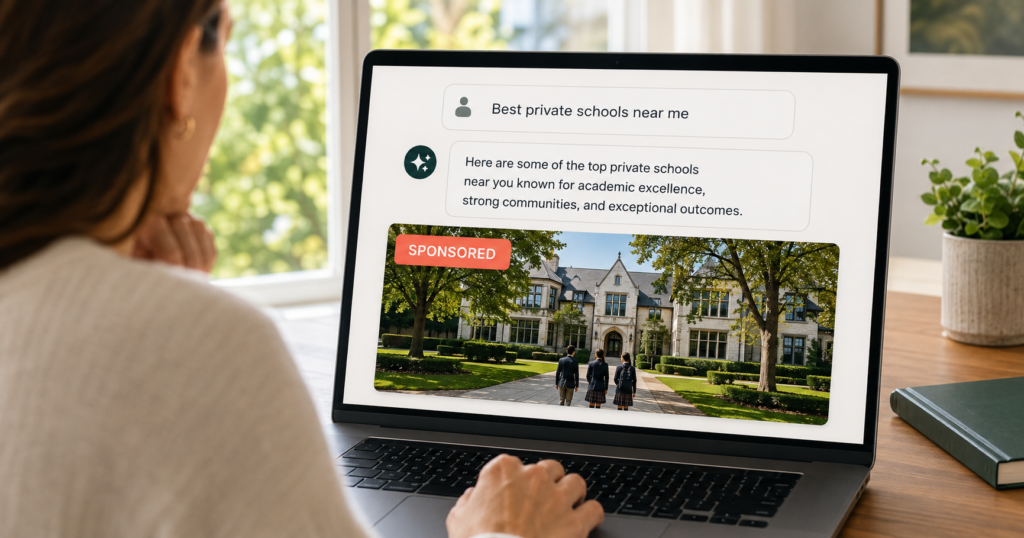
Should schools advertise on ChatGPT? If you oversee marketing or enrollment at a private or independent school, it’s a question that may have sounded ridiculous a year ago. Not anymore.
There was really no chance chatbots would stay organic and not monetize their services.
ChatGPT is taking the lead.
In February, ChatGPT began testing ads, and now, OpenAI Ads are available for school marketing.
I know you’re excited to try it on for size, so let’s keep this blog short and sweet.
What are we even talking about?
OpenAI Ads, aka ChatGPT-sponsored ads, allow your school to show sponsored content based on the conversation a user has with the interface.
For a practical look, here’s a mock example.
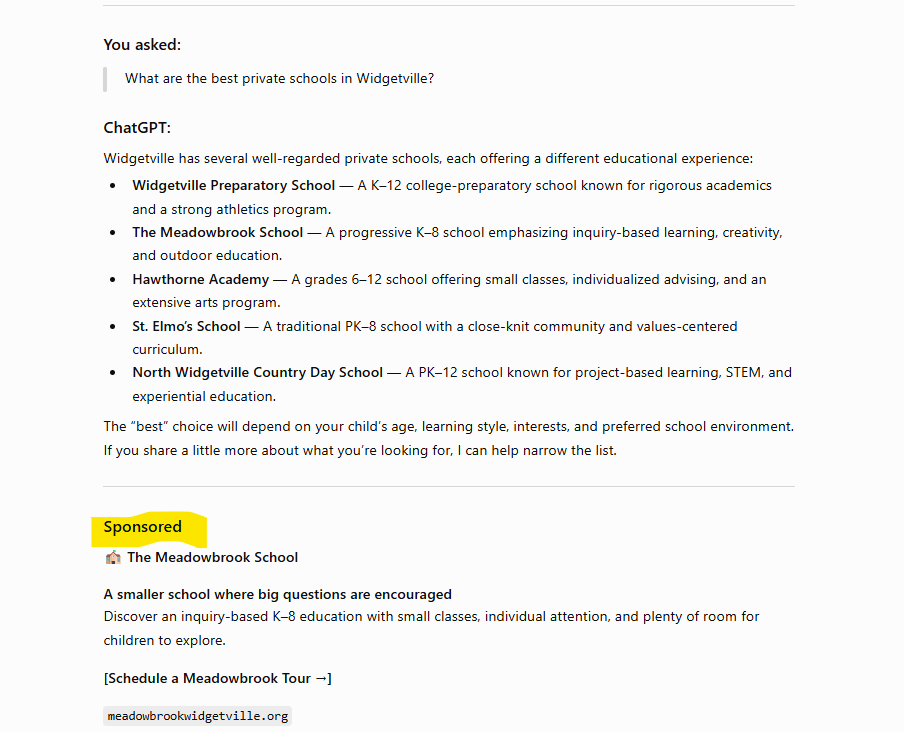
The Meadowbrook School is running this sponsored ad through the OpenAI Ads Manager. The school provides the platform with:
- a URL, landing page campaign ID,
- a headline (up to 50 characters),
- a description (up to 100 characters), and
- an image (that can have text overlay).
Unlike digital marketing platforms like Google Ads and Meta Ads, the current targeting is simply based on optional “context hints.” These hints are meant to help ChatGPT place your ad in relevant conversations. The context hint description in OpenAI Ads Manager reads: Describe the conversations, topics, or keywords where your products or services may be relevant; these hints guide matching but aren’t exact-match targeting rules.
So, should you consider adding ChatGPT Ads to your marketing playbook? Let’s look at the good, the not good yet, and the potential drawbacks.
Pros
- Affluent, highly-educated people are best friends with their chatbot. 33% of your current parent population uses ChatGPT to help “make decisions,” according to Demand Sage, and Backlinko reports 58% of your potential future parents are having complex conversations to make potential life-changing decisions. Deep stuff!
- There’s almost no competition right now. “As of August 4, 2026, I can verify two U.S.-based private K–12 schools that have been captured advertising inside ChatGPT,” said ChatGPT when I asked.
- People don’t go to Facebook or YouTube, cross their fingers, and hope to see an ad for a school, they go to Google…and now, ChatGPT and other LLMs. So, this gives your school an opportunity to get in front of school searches when it matters most; when they are searching with purpose and intent.
- It’s simple to create an account and launch a campaign. Worth mentioning again, you don’t have to create keywords and constantly monitor whether the search terms are relevant. With OpenAI Ads, the system matches your ad to conversations that fit.
Cons
- You don’t have any actual control as to where your ad would be seen. You’re putting a lot of trust in ChatGPT to put them in the right place because you’re only providing
- It truncates headlines and descriptions. After the halfway point (25 characters for a headline and 50 characters for a description, the platform warns that “copy may be truncated in some placements.” That means your message may be cut off at an awkward time, which isn’t optimal for your brand.
- Paying subscribers never see your ad, and plenty of your prospective parents pay for ChatGPT. Students never see your ad either, and we know students influence school choice as early as middle school.
- It’s not cheap. The minimum daily ad spend is $25.
- The sponsored ad is below the organic results. Unlike Google search ads that appear before organic results on page one, OpenAI Ads are below the organic results.
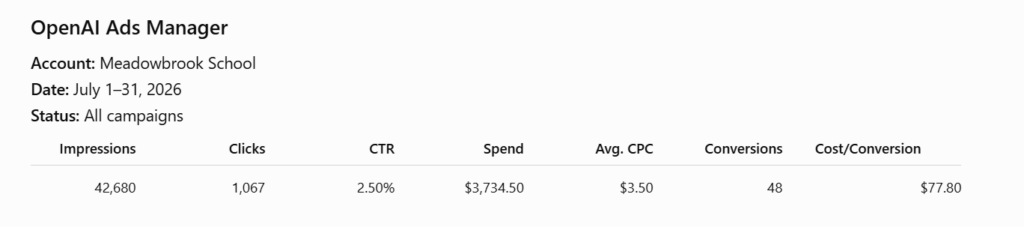
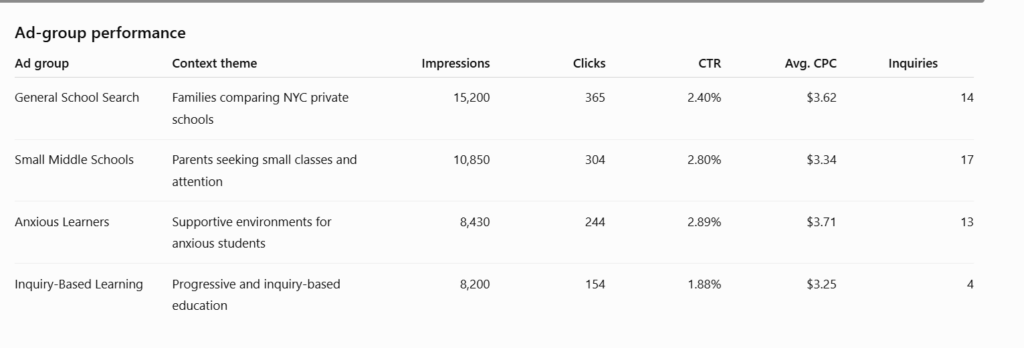
- While you can track data and results (mock screenshot below produced by ChatGPT), there are no industry benchmarks.
If It Were Me
I’d find out whether I needed it first.
Enter every prompt you believe should surface your school. If you’re not on any lists, go for it. If you’re not in the top four, go for it. If you like trying new things, go for it.
If you already sit in the top three for the prompts that matter, hold off for now.
Either way, watch this platform, because, say it with me, it’s where families go when they’re in search and shopping mode.
Getting Started
Setup is easy. The part that gave me the most pause was the context hints, and they’re optional. Don’t sweat them. The platform crawls your website, pays especially close attention to your landing page, and pairs that with your headline and description to show your ad when the opportunity presents itself. An AI matchmaker, if you will.
So If You’re Ready
- Go to ads.openai.com and sign up.
- I’m going ALL CAPS for this one, and some of you Meta marketers know why: CREATE THE ACCOUNT WITH A SHARED EMAIL ADDRESS. Otherwise you become the school that still can’t access Meta Ads Manager because Tim, the tech guy who started your Facebook account, quit with a grudge 17 years ago.
- You’ll land in Ads Manager, where you’ll set up your advertiser account with your school’s name, business details, and a payment method.
- Choose your objective. I’m a fan of Clicks for now because it mirrors Google Ads logic and makes analysis cleaner.
There are more steps, but the platform walks you through them.
Still Have Questions?
- Open ChatGPT
- Ask it
Not happy with the answer, or would rather leave it to the experts? Email me: trevor@truthtree.com

Trevor Waddington, M.Ed.
After years of educating a marketing firm on the nuances of his school, Trevor decided schools deserved a marketing team that understood them AND their audience. And thus, Truth Tree was born.
Frequently Asked Questions about School Ads on ChatGPT
Yes — schools can advertise on ChatGPT now that OpenAI Ads Manager is live, following the same sponsored-placement model as Google and Meta.
ChatGPT ads appear inside conversational answers rather than a search results page, so targeting is broader (geography, headline, description) but far less precise than Google’s keyword- and audience-based system.
It depends on how comfortable your school is trying something new — early movers get to test the platform before it gets more competitive, but it still lacks the detailed targeting and reporting schools get with platforms like Google or Meta.
Campaigns can start as low as $25 a day, with no large upfront commitment required — though schools should expect to spend a few hundred dollars testing before drawing real conclusions.
The biggest risk is your ad showing up next to content that doesn’t match your school’s image — and right now, there’s no reliable way to block those sites in advance.