
You know those ads. The annoying ones that populate the top, sides, and just about everywhere on certain sites.
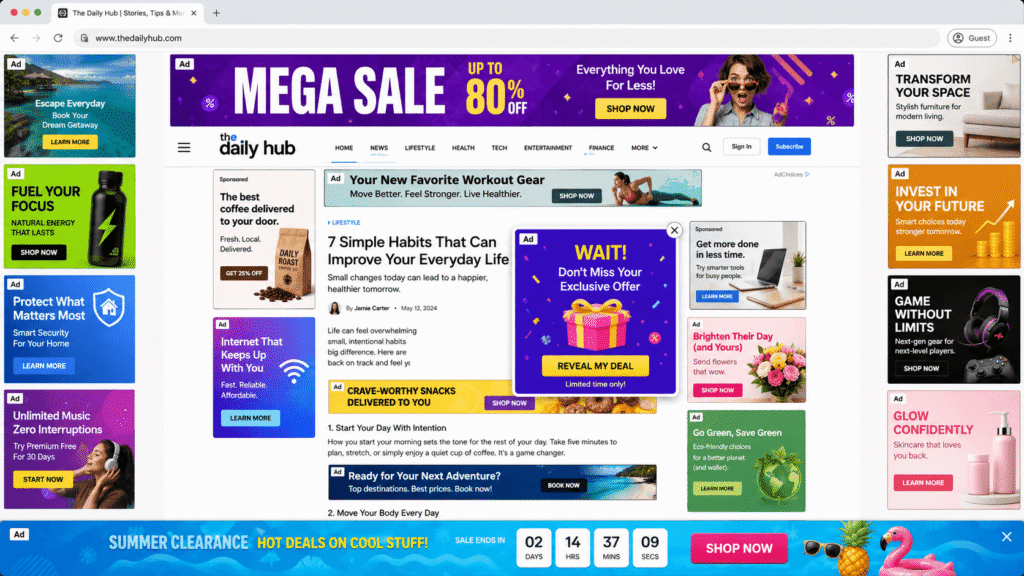
Zoinks! They’re everywhere, but rarely earn quality clicks.
Well, a few months ago, Google announced that traditional standalone Display campaigns are going away. For schools running Display campaigns, this will definitely affect you.
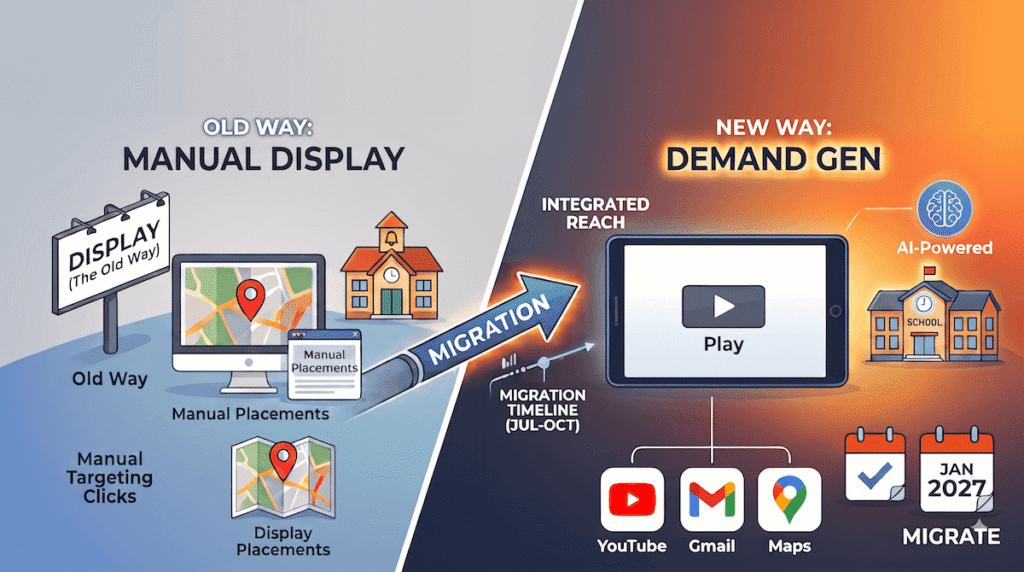
Since we all love bundling, Google is following suit. More to the point, Google is folding Display into Demand Gen, its campaign type that also covers YouTube, Discover, Gmail, and Google Maps.
Before you run off in a panic, let’s look at what you’re losing, what you’re gaining, and what to do.
What Your School Will Lose
Years ago, I wrote about why placements were one of display advertising’s best features for schools. On a site like Private School Review, ad slots sit above the fold, right where a searching parent’s eyes land. You could pick those placements deliberately, put your brand on the sites your best-fit families actually visit, and skip the sites that are low-rent or mission-inappropriate.
Now, not so much. Manual placement targeting is fading away, so directly targeting The New York Times for your Manhattan school or TheBump.com if your school serves 18 months and up is no longer going to be a viable tactic.
A more pressing issue for schools is that migrated campaigns typically need a week or two to find their footing, and performance can dip while the system relearns who your families are. A dip in March is annoying. A dip in October, when inquiry traffic is climbing toward open house season, is a problem.
What Schools Are Gaining
It’s not all bad.
Your remarketing audiences will carry over. That parent who visited your tuition page and bounced in 11 seconds can still see your ad on their favorite fantasy football site the next morning.
You also gain Lookalike segments built from those remarketing lists. This means Google can find parents who behave like the families already showing interest in your school. In our experience, that kind of expansion often outperforms the old interest-category targeting that the current display system leans on.
How does that play out? One campaign can now reach parents on YouTube, in Gmail, on Discover, and across the Display network, with channel controls that let you keep a campaign on Display inventory only if that’s what the strategy calls for. For schools with strong video assets, now’s your chance to use them. For schools whose entire creative library is one horizontal banner from the 2023 rebrand, it’s time to get to work.
What Your School Should Do
- Inventory your display campaigns now. Know what’s running, what it costs, and what it produces. You cannot go back next year and get your old data.
- Use the migration tool. Do not rebuild from scratch. Pausing old campaigns and starting fresh wipes out your performance history and restarts the learning process.
- Start the migration. Get campaigns moved and through the learning phase before the fall inquiry season so the dip happens when nobody’s watching.
- Fill out your creative library. Demand Gen rewards variety: vertical and square formats, short video, and real students and teachers rather than stock photos of children who have never set foot on your campus (I can’t believe I still need to say that).
- Tighten your audience signals. Without placement control, your remarketing lists, customer match lists, and best-fit family profiles become your targeting strategy. Seriously take your time to build them out and refine them as you go along.
- Benchmark before and after. Record your display campaign data so you can compare it to your eventual new data.
- Review exclusions and brand safety settings. PLEASE MAKE SURE YOUR ADS DON’T SHOW ON BRAND-DAMAGING SITES. You don’t want your ad popping up on Barstool Sports or showing up next to an article on the local news website about [think of something awful and put it here].
The Catch
Most schools think this makes it easier, but handing the reins over to an automated, AI-driven campaign type comes with a steep trade-off.
Because Demand Gen relies heavily on algorithmic learning and broad audience expansion, your budget is at a much higher risk unless your negative placements and audience guardrails are dialed in and checked regularly.
Furthermore, Demand Gen hates lazy creative. You can no longer rely on a single, static 300 x 250 banner with a set-it-and-forget-it mentality. You have to continuously provide high-quality assets, or it simply won’t be able to effectively place you across high-value platforms.
In short, Google is doing the tedious work on where your ads go, but you now have to work twice as hard on who you tell it to target and what you show them.
Go! Start now!
And hey, if you want to explore bringing in our team to be ahead of shifts like this on your behalf, drop me an email: trevor@truthtree.com.

Trevor Waddington is the founder and CEO of Truth Tree, the enrollment marketing team built for schools. Drawing on his experience in independent schools and deep study of behavioral science, Trevor explores how families discover, evaluate, and ultimately choose schools.
Connect with Trevor on LinkedIn.
Subscribe to Trevor’s satirical newsletter, The Scallion, written for school leaders.
Frequently Asked Questions About Google Ads for Schools and Demand Gen
Is Google getting rid of Display campaigns?
Google is retiring traditional standalone Display campaigns and folding them into Demand Gen. Display inventory itself is not disappearing. Instead, schools will manage that advertising through Demand Gen, alongside placements across YouTube, Discover, Gmail, and Google Maps.
What is Google Demand Gen, and what does it mean for schools?
Demand Gen is a Google Ads campaign type that can reach families across YouTube, Discover, Gmail, Google Maps, and the Display network. For schools, the shift means less manual control over exactly where ads appear, but more opportunities to use remarketing, Lookalike segments, video, and other creative formats to reach prospective families.
Will schools still be able to run Google Display ads?
Yes. Schools can still reach families across Google’s Display network through Demand Gen. What is changing is how those campaigns are built and targeted. Manual placement targeting is fading away, which makes strong audience signals, exclusions, remarketing lists, and brand safety settings even more important.
Should schools migrate Google Display campaigns to Demand Gen now?
Yes. Schools do not need to wait for Google to force the migration. Moving campaigns now gives Demand Gen time to get through its learning phase before the fall inquiry season. Use Google’s migration tool rather than rebuilding campaigns from scratch, benchmark your current Display performance first, and make sure your audience signals, creative assets, exclusions, and brand safety settings are ready for the change.