
Table of Contents
Where’s the answer?
A middle school teacher recently shared a 6th-grade classroom moment. A student was searching on Google for a theatre assignment, looked up, confused, and asked, “Why are there only links showing up? Where’s the answer?”
The school had turned off Google’s AI Overviews. That student had either never seen a search page without one, or had grown so used to getting an “answer” that a page of links felt overwhelming.
Students that age are already weighing in on where they go to school, and their parents are turning to AI platforms with the same kinds of questions. Does AI-powered search know enough about your school to accurately describe it to searching families?
Let’s walk through it together.
What are SEO, AEO and GEO for schools?
- SEO for schools (search engine optimization) is the work of making your school’s information easy to find, understand and trust wherever families search, from Google and Bing to AI-powered tools.
- AEO for schools (answer engine optimization) puts the emphasis on answers: making your information clear enough that search engines and AI tools can use it to answer a family’s question directly, like in Google’s AI Overviews.
- GEO for schools (generative engine optimization) puts the emphasis on AI-generated responses: helping tools like ChatGPT, Gemini, Claude and Perplexity find, cite and accurately describe your school.
Think of AEO and GEO as areas of emphasis within SEO, not separate strategies. Google itself says optimizing for its AI search features is still SEO, and a single improvement to your website might help you rank on Google, get cited in an AI Overview and shape a ChatGPT answer.
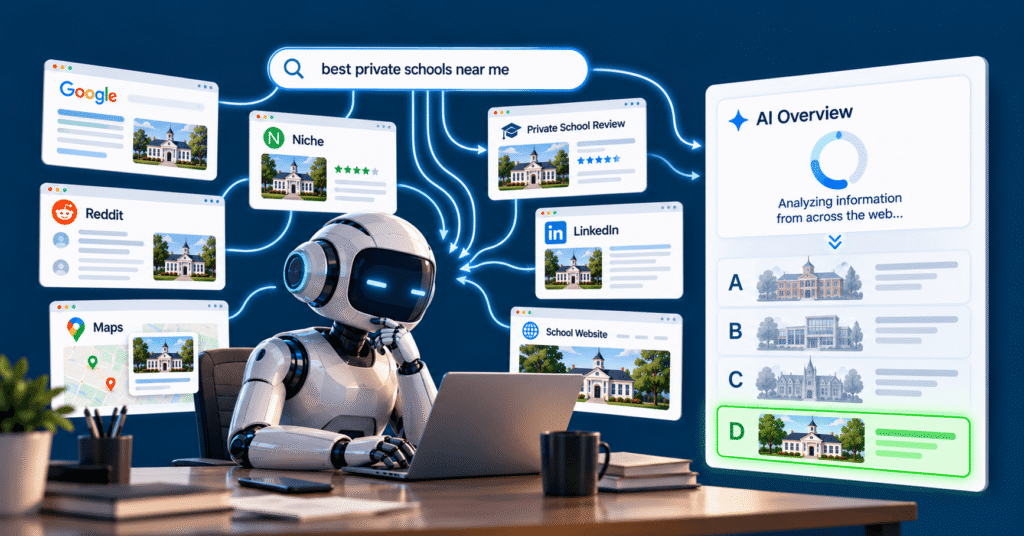
What has changed is how answers get built. Google explains that AI Overviews and AI Mode may use a “query fan-out” technique, running several related searches across subtopics and sources to develop a response. In other words, a family’s one question quietly becomes many smaller searches, and the pages that show up for those searches are the ones AI draws from.
Strong search visibility is still the foundation. It just has to cover more of the questions behind the question. That means the fundamentals still matter: a technically healthy website, relevant keywords and useful content that answers the questions families are actually asking.
How families search for schools now
Families have more ways to research a school than ever. They scroll Facebook, Instagram and TikTok. They visit your website and read reviews on Niche and Private School Review. And more and more, they ask an AI tool directly: “Which of these two schools is a better fit for a child who loves robotics, soccer and theater?”
It isn’t a linear journey. Families move between all of these channels and do much of their research before they ever reach out, so the signals they find along the way shape which schools make their shortlist.

She’s juggling two kids and a job. When she finally has five minutes to research schools, will she find yours?
What strong visibility looks like for a school
Your website answers parents’ real questions
In our work with schools, we often find that the information families need most is either difficult to find, scattered across multiple pages, or missing entirely.
Parents want to know about tuition and financial aid, your approach to reading or learning differences, and whether their child will fit in.
If your website doesn’t answer those questions clearly, other sources will answer them for you: a review site, a parent forum, Reddit or a school directory. Some of that information may be accurate. Some may be outdated or wrong. And search engines and AI tools can connect those sources to your school and use them to describe you.
Your school is accurately represented across the web
Your directory listings, social profiles and other mentions should tell the same accurate story about your school. An outdated grade range on Niche, a program that no longer exists or an old tuition figure can create confusion for families and give AI tools conflicting information to draw from.
AI tools describe your school accurately
In AI answers, your school being mentioned, your website being cited and your school being recommended are three different outcomes, and one doesn’t guarantee the others. Showing up isn’t a win if the information is wrong. The goal is accurate, relevant information that helps the right families recognize your school as a fit.
There’s a behavioral science connection here, too. Automation bias can lead people to place greater trust in AI-generated answers, even when those answers aren’t entirely accurate. That’s one more reason it matters how AI tools describe your school.
Source: Wired to Enroll, Chapter 3
SEO for schools: a quick visibility checklist
Families are looking for schools like yours. But can they find you? And when they do, are they getting the information they need to decide whether your school is right for their child? Rich Tatum, Truth Tree’s Director of Organic Search, put this checklist together.
See where your school stands.
1. Can families find your school?
- Your website clearly explains where your school is located, which grades you serve and what makes your school different.
- Your Google Business Profile is complete, accurate and up to date.
- Your website works well on mobile phones, with important information easy to find.
- Your school has dedicated pages explaining its divisions, programs and admissions process.
2. Does your website answer parents’ questions?
- Families can easily find tuition, financial aid, application requirements and important deadlines.
- Your website answers questions about academics, learning support, extracurricular activities, school culture and other things parents care about.
- Important questions are answered clearly, without making families dig through multiple pages or contact admissions for basic information.
- Parents can easily take the next step, whether that’s asking a question, scheduling a tour or starting an application.
3. Is your school accurately represented across the web?
- Your school’s basic information, including location, grades served and programs, is accurate on Niche, Private School Review and other school directories.
- Your social media profiles contain current, accurate information about your school.
- Families can find authentic reviews, testimonials and information about your teachers and school leadership.
4. Do you know what search engines and AI tools are saying about your school?
Keep in mind that AI answers change from one ask to the next, so a single check is a snapshot. Patterns over time tell you more.
- Keep in mind that AI answers change from one ask to the next, so a single check is a snapshot. Patterns over time tell you more.
- You’ve recently searched Google for schools like yours in your area to see whether your school appears.
- You’ve asked ChatGPT, Gemini or another AI assistant to describe your school and checked the answer for accuracy.
- You’ve asked AI tools to recommend schools for families whose needs match your school’s strengths, and checked whether your school is mentioned.
- Someone on your team periodically checks how your school appears across search engines, directories and AI platforms.
What did you find?
If you couldn’t check every box, you may have found an opportunity to make your school easier to find, easier to understand or more accurately represented online. And if you weren’t sure how to answer some of these questions, that’s worth looking into, too.
The bottom line
SEO, AEO, and GEO work toward the same goal: helping families find accurate, useful information about your school wherever they search. The tools may change, but the priority doesn’t. Make it easy for families to find you, understand what makes your school different, and decide whether you’re the right fit.
Has SEO become a priority for your school?
Schools that show up organically in a family’s search carry a lot of weight.

Missy Speyrer came to Truth Tree after 8 years at an independent school in South Louisiana. From branding and marketing to social media and auxiliary programs, she is no stranger to working alongside a lean team to get too much done in too little time.
Now, she curates insightful content to support school marketing and enrollment teams aiming to amplify their digital reach with right-fit families.
Want to see if Truth Tree is the right team for you?
Frequently Asked Questions about SEO for Schools
What’s the difference between SEO, AEO, and GEO for schools?
SEO is the broad work of making your school’s information easy to find, understand and trust wherever families search. AEO and GEO are areas of emphasis within it: AEO focuses on getting your information used as a direct answer, and GEO focuses on how AI tools like ChatGPT find, cite and describe your school. They overlap and work best as one strategy.
Is SEO dead for schools now that AI answers questions?
No. SEO has always been about making information easy to find wherever people search, and AI tools are now part of that. Google says optimizing for its AI search features is still SEO. What’s changed is that schools need to think beyond Google rankings to every place families look for answers.
How do I know if SEO is working for my school?
For Google, Search Console shows how your school appears in search results, including AI features, alongside website traffic and inquiries. For AI tools like ChatGPT, it means checking the questions parents actually ask over time: Is your school mentioned, cited or recommended, and is the information accurate? Keep in mind that a mention isn’t a lead, and an AI recommendation isn’t an enrollment. The goal is visibility that brings the right families to you.
How long does SEO take to work for a school?
SEO is a long-term investment. Most schools see early movement within a few months, with stronger, steadier results building over six months to a year, depending on the school’s market, competition and starting point.
How can my school show up in AI search results like ChatGPT and Google AI Overviews?
AI tools pull from many sources, and they don’t all see the same information. Some answers come from a tool’s own search, and some from what it learned during training, so updates to your website may take time to show up. Schools that are described accurately tend to have clear answers on their own websites, consistent information across directories like Niche and Private School Review, and credible mentions from other sources.
How do we expand our school’s SEO strategy to include AEO and GEO?
You don’t need three separate strategies. Start by finding out where you stand across search engines, directories, and AI tools. From there, the same core work, like clear answers to families’ real questions and accurate information across the web, supports all three. Truth Tree helps independent schools build that into one enrollment marketing strategy.