
Table of Contents
How are we measuring school marketing? Is it even working?
If you work in independent school marketing or admissions, I’d bet you’ve asked yourself a version of these questions (probably more than once this week!). I know I did when I was a school marketing and enrollment director, and now, at Truth Tree, where we work with hundreds of private schools worldwide, it’s the question I hear more than any other.
It usually comes out sideways. A school will tell me they’re running Google Ads and Meta ads, they just launched a beautiful new website, social is active, and there’s a real budget behind all of it. They’re doing all the things. And then, in the same breath, I hear: “Honestly, we’re just not getting much back.” Or “Word of mouth is where all our families come from.” Or my personal favorite, “Maybe digital just doesn’t work for schools.”
I heard it so often that I finally decided to answer it. I spent the last six months digging in with our team and our partner schools, and I shared what we found at the Enroll26 Conference alongside Meghan Hodgin, Director of Marketing and Communications at Oak Knoll School. This post is the written version (slightly less caffeinated, I promise).
Spoiler alert: digital is working. You just can’t see most of what it’s doing.
Parents did not get the memo about your funnel
We all have this picture in our heads: a parent sees an ad, clicks, fills out the inquiry form, tours, applies, and enrolls. It’s a clean, beautiful line. At Truth Tree, we call that a unicorn because it doesn’t exist.
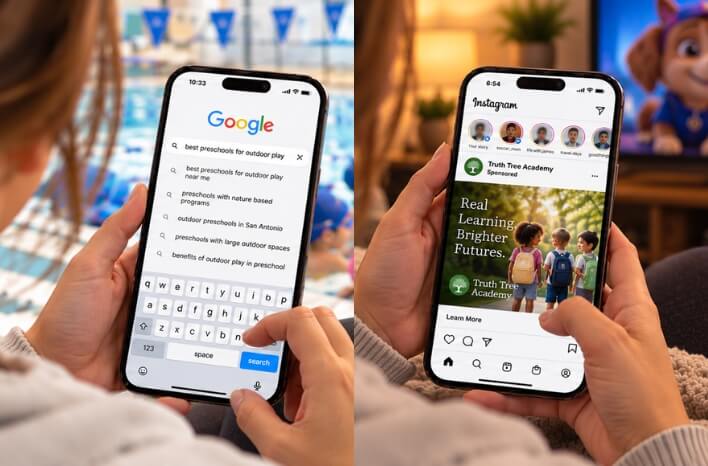
Think about the last time you bought a pair of running shoes. (Be honest!) You probably Googled around a bit, then went to yoga, made dinner, and forgot all about it. A few days later, you remembered and asked ChatGPT for the best shoes for someone getting back into running, and maybe even had it compare three pairs based on your size and your goals.
Then the ads started following you everywhere–Instagram, Facebook, Google. (Your partner probably started seeing running shoe ads too, for no reason at all.) You read the reviews, texted your running buddy to ask what she wears, checked colors and sizes, maybe tried a pair on at your local running store, did a quick price check… and then said forget it and ordered them on Amazon.
Sound familiar? Me too. So which one of those touchpoints actually “caused” you to buy the shoes?
And that was the journey to buy a pair of shoes.
How Much Do Parents Research Before Choosing a School?
Choosing a school is one of the biggest trust decisions a parent will ever make. They’re not buying a product; they’re choosing a community, relationships, an experience, and ultimately, their child’s future. It’s emotional, it’s expensive, and it’s not a one-year commitment. At a Pre-K through 12 school, a family could be with you for fourteen years!
So think about how much research you did for a pair of sneakers, and then think about how much research a parent does before they hand you their child. We actually asked. In our survey of 132 newly enrolled private school families, 54% started their search online, and almost all of that research happens before they ever talk to your admissions office.
What Is the Dark Funnel? (aka Where Families Go to Lurk)
This is where I really went down the rabbit hole.
From our side of the table, digital looks great. The ads are performing, the keywords are spot on (these families are actively looking for a school!), visitors are spending real time on the website, and our schools are showing up in ChatGPT. We’re crushing it, and honestly, I’m obsessed.
And then families just… disappear. For days, weeks, months, and sometimes years. In that same survey, almost half of families (47%) spent a year or more researching schools before they enrolled. And this similar tale showed up in the EMA (now, E3n) Ride to Independent School report where a resounding 76% of families researched for 12+ months before enrolling.
That’s a lot of time to lurk. Families are reading, comparing, and talking to friends, but they aren’t ready to fill out your (way too long) inquiry form–long forms were one of the top website complaints families gave us–and they’re definitely not ready for a tour. They’re just hovering, and you can’t see any of it.
We dug into the school shopping journey more in a recent blog post titled School Marketing Qualified Leads Are Missing from the Funnel.
Meanwhile, admissions is getting antsy. We’re getting all of these clicks, so where are the inquiries? Spoiler: clicks were never the right scoreboard anyway. Then a family enrolls, says they heard about you from a friend, and everyone decides digital didn’t do a thing.
Here’s the part that surprises most schools: the inquiry form isn’t the beginning of the journey. It’s the beginning of the end. By the time a family fills it out, they already have pretty solid opinions about you, and some skip the inquiry altogether and go straight to applying, which is exactly what we highlighted in A Shift in the Admissions Funnel: Inquiries Down, Applications Up.
Stop Chasing Credit: Why School Marketing Attribution Fails
This is where we need to change the conversation.
You can’t prove which tactic gets the “credit” for an enrolled student–not digital, not anything. Nobody walks into your office holding the postcard you mailed and says, “This is how I found you!” The same goes for the billboard and the new signage. Marketing has never been an exact science.
“How did you hear about us?” is doing its best, but parents did about nine million things on their way to you. Do they really remember the first one? Does the first one even matter that much? And what about all of the work that got you visible, built their confidence, and kept them moving through that dark funnel long enough to finally raise their hand?
It’s not just schools wrestling with this, either. Marketers in nearly every industry are landing in the same place: asking people how they heard about you and tracking what they do online are two different kinds of evidence that work best together, not a contest where one wins.
So let’s stop chasing credit and start collecting evidence. Perfect attribution won’t happen, but better evidence absolutely can.
Word of mouth isn’t word of mouth anymore
Meghan said this better than I can at Enroll26, so I’m borrowing her bit.
When a family writes “friend” on the inquiry form, that friend is probably real. Happy families talk, and we love that! But word of mouth isn’t just friends anymore. Parents search Instagram for the best summer camp in town, ask ChatGPT for the best girls’ school with a strong STEM program nearby, and read reviews on Niche. That’s word of mouth now: social proof from sources people trust.
So “Friend” goes in the database. But what actually happened? They Googled you, read reviews, checked Niche, followed you on Instagram, asked ChatGPT, browsed your website for months, compared you to three other schools, saw an ad on Facebook for an admissions event, and THEN came to an open house. The source gets the credit, the influence disappears, and digital usually doesn’t get its fair share.
The data backs this up, too. In our family survey, 62% of parents said talking to current families helped them decide. Niche’s K-12 parent pulse survey found that 74% of parents would cross a school off their list because of negative feedback from other parents, and 89% said a school’s presence on search and review sites influenced them.
And the AI piece is moving fast. In that 2024 Niche survey, only 1% of parents said they used AI chatbots to research schools. By 2026, EAB found that 57% of parents of high schoolers had used tools like ChatGPT to research colleges. It’s a different audience, I know, but it’s heading in the same direction.
If you want to dig deeper, we’ve written about modernizing your word-of-mouth strategy, why school reviews build trust, and how to get your school mentioned in AI search.
How to Measure Private School Marketing: The Enrollment Momentum Toolkit™
All of this is why I built the Enrollment Momentum Toolkit™. It’s a free spreadsheet that gets marketing and admissions looking at the same picture (we’ve got more ideas on building that alignment too), in five steps:
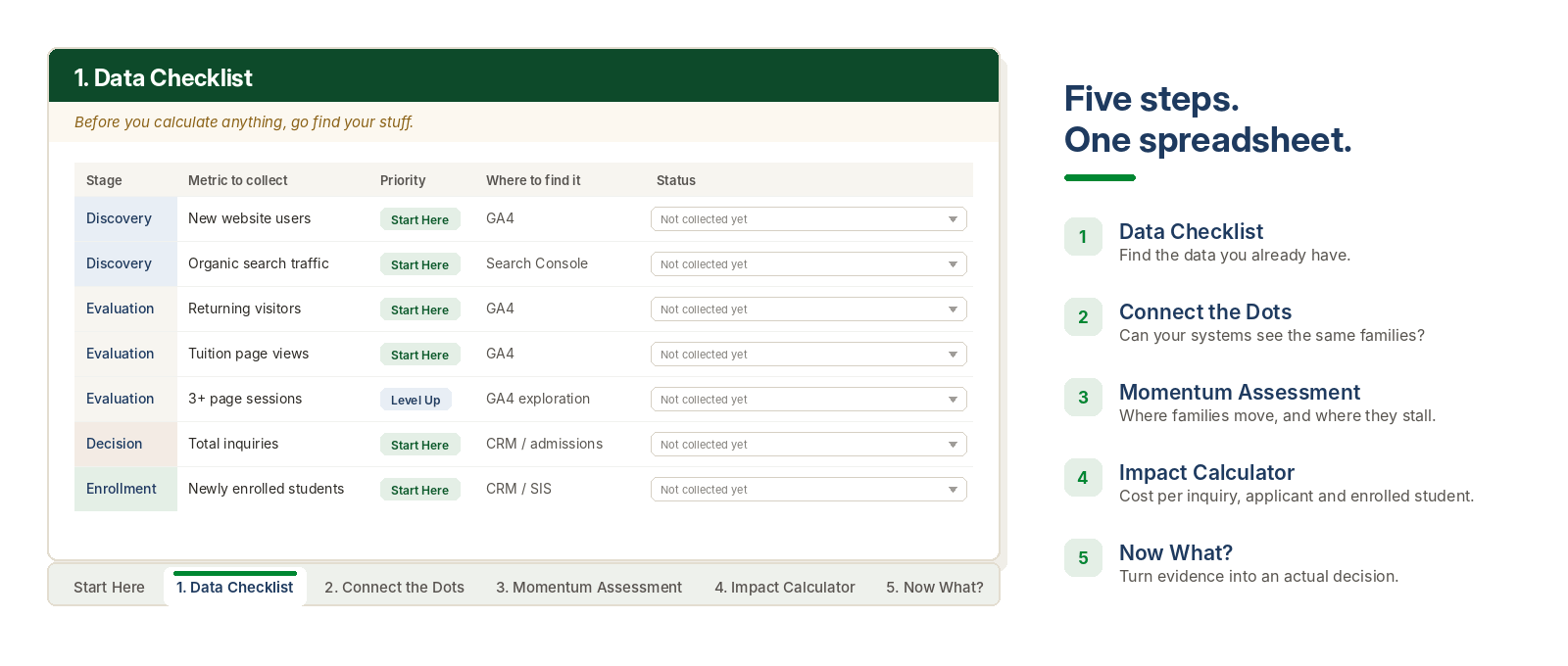
- Collect the data you already have (there’s a checklist, sorted into Start Here, Level Up, and Bonus Points)
- Connect your marketing and admissions systems so they can recognize the same families
- Assess where families are moving and where they stall: Discovery, Evaluation, Decision, Enrollment
- Calculate cost per inquiry, cost per enrolled student, and lifetime value (math, but useful)
- Act on it, because otherwise… congrats on the dashboard
You do NOT need every data point to get started. Start with what you have, and if you land on “No Data” somewhere, you’ve found your first measurement project!
And if you only do one thing this month, make it this: export your marketing leads, export your inquiry list, and match them on email. That’s it. That’s this month’s measurement focus.
Perfect attribution isn’t the goal
Meghan closed our talk with this, and I can’t stop thinking about it. She still can’t prove that digital alone enrolled a single student, but she can show her board that one in four of their newly enrolled families found them online, what that cost, and what those families were doing before they ever called. And that’s enough evidence to make a good decision.
So what are you trying to prove at your school?

Liz Zweigle serves as the COO at Truth Tree, leading a diverse team of digital marketing experts and former school admissions, marketing, and leadership professionals. With 15 years of experience in school operations, Liz integrates her wealth of knowledge into daily conversations and collaborations with both the team and school partners.
Passionate about supporting schools and enhancing their digital reach, Liz is always brainstorming solutions and serving as a trusted advisor for strategic initiatives.
Frequently Asked Questions about Measuring School Marketing
How do I know if my school’s marketing is working?
Stop looking for one tactic to take the credit and start collecting evidence instead. Match your marketing leads to your inquiry list on email, track where families stall between discovery and enrollment, and calculate cost per enrolled student. You won’t get perfect attribution, but you’ll get enough to make good decisions.
Why does every family say they heard about us through word of mouth?
Because the friend is real, and the friend is memorable. But before that conversation, most families Googled you, read reviews, checked Niche, followed you on Instagram, and maybe asked ChatGPT. The inquiry form captures the last thing they remember, not everything that got them there.
What is the dark funnel in school admissions?
It’s the stretch where families are researching your school but you can’t see them. They’re reading, comparing, and talking to friends, sometimes for a year or more, without filling out a form. In our survey of newly enrolled families, 47% researched for a year or more before enrolling.
How long do families research private schools before enrolling?
Longer than you think. Almost half of the families in our survey spent a year or more researching schools, and 54% started their search online. Most of that research happens before they ever talk to your admissions office.
Is “How did you hear about us?” still worth asking?
Yes, but don’t treat it as the whole story. Parents did about nine million things on their way to you, and they’re not going to remember the first one. Pair the answer with what you can track online. Together they tell you far more than either one alone.
Are parents using ChatGPT to research private schools?
More every year. In Niche’s 2024 survey, only 1% of parents used AI chatbots to research schools. By 2026, EAB found 57% of parents of high schoolers had used tools like ChatGPT to research colleges. Different audience, same direction.
What’s the easiest way to start measuring school marketing?
Export your marketing leads, export your inquiry list, and match them on email. That’s it. That’s the project. If you want a framework for what comes next, the free Enrollment Momentum Toolkit walks you through collecting, connecting, assessing, calculating, and acting on your data.